




Willing to join the digital wallet market, but unsure, how to get started? That’s a very understandable riddle, considering that to obtain a product, you need to find the perfect tech vendor, and tech vendors are everywhere. How do you prepare for the collaboration? What should you pay special attention to when evaluating candidates?
We’ve gathered answers to these and many more questions in this article. If you want to make a confident move in the right direction, keep reading.

written by:
Andrei Kvasov
Senior Software Developer
Sketching a Bigger Picture
The Weight of Responsibility
Digital wallets are everywhere, and the demand for them is growing by the minute. As Capital One Shopping Research reports, there are over 3.4 billion digital wallet users globally. In 2023 alone, due to online shopping, these payments accounted for 50% of all transactions.
Eager to fit in to the cashless reality, business are launching progressively more forward-thinking solutions. As a result, in 2025, the mobile wallet market was estimated at USD 266.85 billion, and it is projected to reach USD 638.54 billion by 2030, growing at a 19.06% CAGR between 2025 and 2030. You know what’s particularly curious? There are about 30,000 fintechs in the world — and this figure doesn’t take into account established IT services providers that tackle multiple industries.
Why all the stats? To tell you: we see you. The struggle of choosing the right tech vendor for your digital wallet platform is real. Being wrong about a company can lead to many troubling consequences, such as:
- the loss of time and consequently delayed product launch;
- financial losses;
- security vulnerabilities;
- scalability and performance issues halting your growth;
- reputational damage and distrust of all major stakeholders — investors, regulators, and, above all, customers.
On the other hand, a reliable tech partner opens doors. You can hit the market with a high-performing eWallet — one that maximizes both revenue and user engagement. With the right collaborator, you can also occupy a specific market niche and gain a significant competitive edge. But the origin of all that success is you.
A vendor’s job is to bring your vision to life — carefully refined with their expertise and experience. Your job is to communicate that vision, as clearly as possible. And that is exactly your starting point: before embarking on a journey of vendor exploration, zoom in on every facet of your own business.
Getting Started
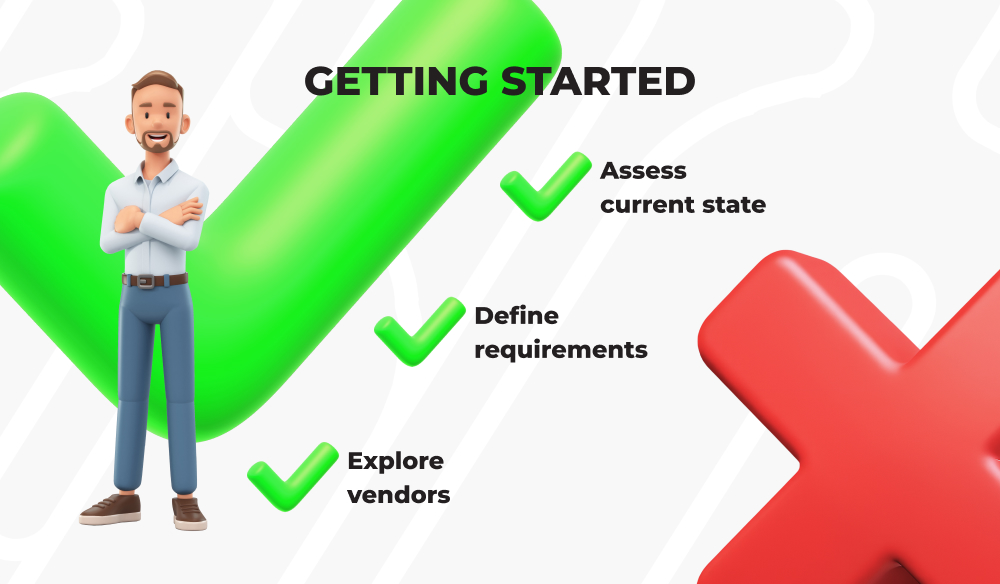
- Begin with a thorough analysis of the current state of your organization
Conducting an internal audit is a perfect way to assess it. The audit helps identify gaps in performance and highlights areas for improvement. Another step you can take is interviewing major stakeholders to gather information from various perspectives.
- Use the analysis to identify high-level requirements
It’s crucial to outline the features of your product, business goals, constraints, and expectations, as this is what potential tech vendors will look into during the pre-study phase. The clearer your vision, the easier it will be for both sides to evaluate the fit. It is also critical to define your budget to avoid misunderstandings or disappointments.
- Get to know the candidates
Based on your goals, needs, and recommendations, create a list of potential vendors. Then, kickstart vendor evaluation.
This process is not an easy one, with quite a few potential pitfalls to consider. To help you navigate the tricky waters of vendor hunting for an eWallet solution, we’ve assembled a list of assessment criteria — along with example questions to ask. Let’s move on to that section.
Is This a Ten? How to Evaluate Potential Tech Vendors
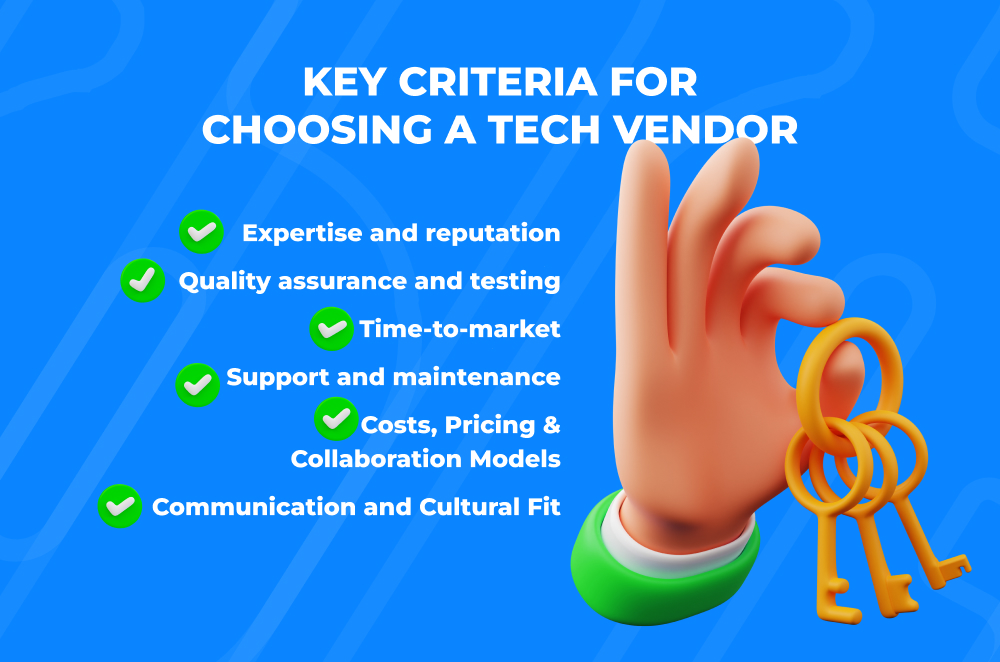
1. Expertise and Reputation
It is crucial to find a tech vendor with a proven track record in fintech development. To make sure nothing escapes your attention, here’s what you should keep in mind:
- Inquire about the company’s tech stack, supported platforms (web, mobile, desktop — if that’s relevant to your case), and the domains they usually work in.
- Is there a proper business fit? Do they offer an eWallet platform as an off-the-shelf solution, or is customization available? If so, how does that impact time-to-market?
- Learn about the team: what qualifications and certifications do they hold? What’s the employee retention rate? How long do team members typically stay with the company?
- Review how the vendor handles security and compliance. Do they support end-to-end encryption, two-factor authentication (2FA), and secure authentication flows? Can they provide audit records or reports?
- Ask about available APIs and third-party integrations — like payment gateways, KYC providers, CRMs, etc. These indicate how interoperable, flexible, and scalable your system will be — and how easily it can be updated in the future.
- Find out whether they have collaborated on projects similar to yours — particularly eWallet platforms.
- Case studies, client testimonials, and feedback from past employees found online (not on the company website!) are crucial.
- Finally, look into any awards or industry recognition — especially if you’re considering a larger, more established company.
2. Quality Assurance and Testing
Will your digital wallet platform function as promised? That depends on how thorough a vendor is with their quality assurance and testing routines.
- Does the vendor follow a well-defined QA process? When and how do they perform unit tests, integration tests, regression testing, and user acceptance testing (UAT)?
- Do they apply both manual testing (for usability and UI/UX evaluation) and automated testing (to assess performance, stability, and scalability)?
- Do they provide concise testing documentation like bug reports and release notes for a better visibility into their quality management?
3. Time-to-Market
Having a comprehensive, structured approach to product delivery is key — if project management is not sufficient, deadlines will never be met.
Your job is to study the proposed MVP delivery timeline and determine whether the vendor consistently launches products on schedule. Also, ask about the company’s typical delivery process:
- What does their workflow look like?
- Do they provide detailed project plans and milestones?
- How do they navigate priority shifts or changing requirements mid-development?
4. Support and Maintenance
Readiness to provide post-release support indicates a strong tech vendor: they demonstrate accountability for the product they’ve built, ensure its smooth operation going forward, and show commitment to long-term collaboration. For a high-stake industry like fintech, that’s gold.
- Find out if the company provides clear technical documentation that will enable others to understand, use, and troubleshoot the eWallet platform.
- Ask about the scope of their maintenance services, terms of work, workflows for bug fixing and releasing updates.
- If it’s something you’re interested in, inquire whether they offer onboarding and training for in-house teams.
5. Costs, Pricing & Collaboration Models
A reliable vendor will clearly break down the initial product cost and inform you about any potential expenses in the future.
Different companies offer different payment models, each suited for specific needs. For example, at Qulix, we offer Fixed Price and Time & Materials.
- With Fixed Price, a signed contract defines the scope and budget, so you can rest assured the cost won’t exceed your limit.
- With Time & Materials, you pay for the hours worked. This model encourages flexibility and is perfect for companies with larger budgets and more extended timelines.
Collaboration models also fall into different categories. They define how you and the vendor will work together:
- They can provide full-service development and manage everything end to end.
- You can opt for a setup with shared responsibilities.
- Team extension is another option, perfect when you're short on resources and just need some extra support.
The choice of a cooperation model depends on your internal resources, project scope, and how much control you want to keep.
6. Communication and Cultural Fit
Last but definitely not least, this criterion is tremendously important. Even if things are going great technically, a mismatch in interpersonal dynamics can undermine your project.
- Make sure your work values align with the vendor’s and that you’re comfortable with their communication style — responses are timely, and the level of formality suits you.
- Look for mutual respect, openness to honest dialogue and feedback, and genuine interest in your project.
- Regardless of where you are in the world, the communication between you and your vendor will happen online. Make sure that the tools and practices they use to keep clients in the loop — as well as the frequency of the syncs — work for you.
In Case You Wanted That Briefly
Criterion for Evaluation
What to Look For
Expertise and reputation
Case studies, employees reviews, client testimonials, team certification, audit results — anything that validates the vendor’s experience and credibility
Quality assurance and testing
A clearly defined QA process covering unit tests, integration tests, regression testing, and user acceptance testing — plus testing documentation
Time-to-market
A well-structured MVP release timeline and detailed project planning
Support and maintenance
Scope of post-release services, terms of support, and availability of technical documentation
Costs, Pricing & Collaboration Models
Transparent cost breakdowns and clearly articulated approach to work
Communication and Cultural Fit
Alignment on work ethics, communication style, and a demonstrated openness to dialogue and feedback
The Checklist: How to Make the Right Call
Need an outlined plan for locking down the right vendor? We’ve got your back. Here is a checklist to ensure you’re not missing any key steps in the vetting process — plus extra tips to help you succeed in your eWallet launch journey.
- Get serious about your business objectives. Clearly define what you want to achieve and what resources or systems you currently have — your goal is to deliver this message clearly to potential vendors.
- Once you shortlist the candidates, evaluate them using the criteria from the previous section. Don’t skip the reputation check — client reviews, certifications, awards, and employee feedback will give you a glimpse behind the curtain.
- Pro tip: pay close attention to post-release support and the vendor’s overall commitment to clients. You don’t want to partner with someone who blindly says “yes” to every idea you promote — you're looking for a tech ally who will help you polish your idea, not bury your project in unfeasible, low-priority features.
- On the same note: assess how well the team understands you, the journey ahead, and exactly how strategic they are about it. Are they after short-term wins or long-term success? A McKinsey reports shows that companies prioritizing strategic partnerships are 2.5 times more likely to achieve their business goals. So if a vendor is ready to invest in you, that is a very good sign.
- After initial evaluations, you will likely schedule meetings to get to know the teams in person. Technical expertise is key — but during these calls, pay special attention to communication style and cultural alignment. These “soft” factors can make or break the collaboration.
- Next, request a formal proposal. Ask each company to compile a Request for Proposal (RFP), and then compare their offerings. Take into account both what’s realistically included and the findings from your earlier research to make an informed decision.
Why You Should Choose Qulix for eWallet Delivery
Let us introduce you to a strong candidate for the role of your tech partner — Qulix.
About Us
Qulix is an international IT company focused primarily on fintech — 80% of what we do falls within this domain. We have been on the market for 25 years, securing multi-year contracts with clients across the globe and fostering strong internal ties: the employee retention rate is a proud 92%.
We deliver cutting-edge ready-to-use products with ample room for customization. Our solution range includes everything from digital wallets to crypto fund platforms and crowdfunding products.
The Qulix team will be happy to help you launch the perfect eWallet on time and tailored to your needs.
Our Approach
Here’s what a typical process of obtaining a digital wallet platform looks like when you partner with Qulix. Though timelines and steps may vary depending on your case, MVP delivery usually takes just 3 to 4 months:
- NDA signing. Regardless of what happens next, this is the first step.
- Pre-study. 2 to 4 weeks. We thoroughly analyze client’s business requirements, explore integration options, define business logic, select the tech stack and architecture, and create a UI/UX design concept. Then, we finalize the project roadmap and other key steps to set the process in motion.
- PoC (Proof of Concept). 4 weeks on average. The Qulix team works on 1–2 key features of the future product, performs basic integration with external components, and conducts a test run to verify the smooth execution of the main scenarios. Then, we deploy the product in a white-label design within a test environment.
- Beta MVP. 4 to 8 weeks. The release of the MVP functionality. A finalized UI/UX replaces the white-label design.
- Friends & Family testing/Go live. 2 weeks on average. The solution is deployed to the production environment. We gather feedback from early adopters to refine the eWallet before the big launch. We also set up processes for continuous improvement and support.
- Continuous development. The Qulix team delivers the rest of the functionality from the project roadmap.
The Best Possible Outcome
Some things are easier said than done — and the release of a top-tier eWallet is one of them. But with the right tech partner, you will face significantly fewer bottlenecks down the road — and yes, you will launch a quality product that can lead you to a strategically calculated, long-standing success.
Evaluate the candidates properly, but be honest with yourself: are you open to dialogue and feedback? Compromises are inevitable — so make sure they are coming from a clear understanding of the bigger picture rather than the fear of losing control.
In any case, now you know the drill. Time to take that first step, isn’t?
Ready to make an impact? Contact us — and we’ll schedule a free online consultation to discuss your project. Your eWallet deserves to be brought to life.




Feel free to get in touch with us! Use this contact form for an ASAP response.
Call us at +44 151 528 8015
E-mail us at request@qulix.com


Feel free to get in touch with us! Use this contact form for an ASAP response.
Call us at +44 151 528 8015
E-mail us at request@qulix.com


