



The faster you release your digital wallet, the higher your chances of getting ahead of your competitors. However, in pursuit of speed, it’s important not to sacrifice quality as users value the functionality and reliability of their apps. They easily delete applications due to software bugs, slow loading times, ineffective user interface, and poor security features.
This is where a minimum viable product (MVP) comes to help you, allowing you to quickly enter the market, test the architecture, transaction speed, and compliance requirements, as well as collect feedback from real customers to later make improvements. We’re going to tell you how long it will take to create an MVP, what kind of team you need for this, and what tools you should choose. Let’s go!

written by:
Alexander Arabey
Director of Business Development

Contents
The Strategic Timeline: From Concept to Kickoff For 10 Weeks
A successful e-wallet launch doesn’t start with a line of code, it begins with a clear understanding of the timeframe. Releasing too early can lead to loss of trust due to unpolished functionality while delaying too much can lead to missed market momentum. A well-designed 10-week timeline is not a compromise between speed and quality but a launch management tool that will help you break into the market with just the right level of maturity to make your first trades, gather feedback, and accurately assess future developments.
Stage
Duration
Key Activities
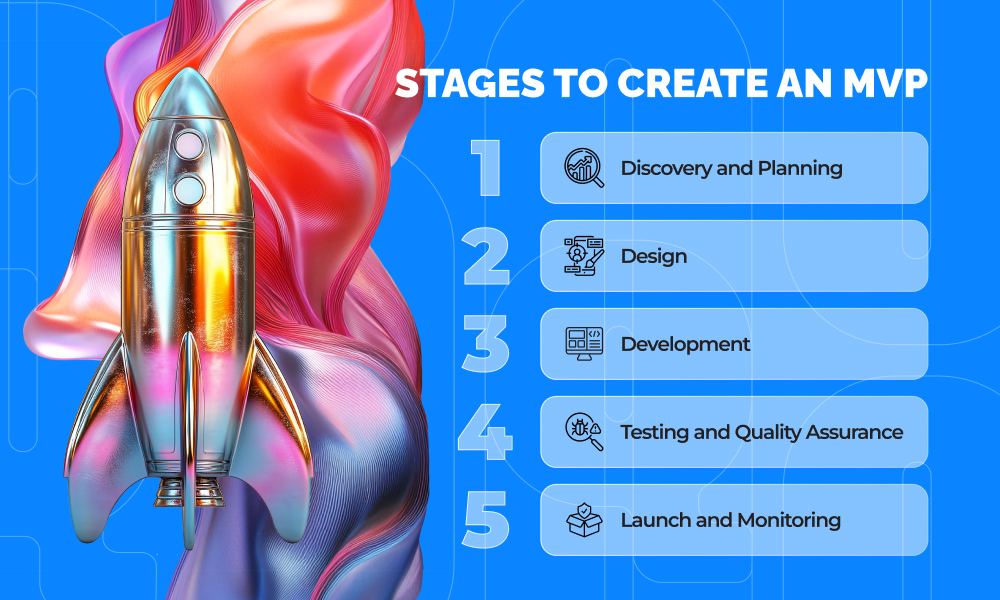
Discovery and Planning
2 weeks
Audience analysis, hypothesis formulation, feature prioritization, compliance requirements verification
Design
2 weeks
Interface design, making prototypes, user flow scenarios, collecting initial feedback
Development
4 weeks
Implementation of main modules, backend/frontend development, payment & KYC integration, security system configuration
Testing and Quality Assurance
1 week
Carrying out various tests, security audit, data protection, fallback scenarios
Launch and Monitoring
1 week
Public launch, real-time monitoring, onboarding, first user activity
Stage 1. Discovery and Planning
At this stage, you set goals, study the market, and determine which features are really important to bring to the table. You need to clearly understand what is worth building, for whom, and why. Market research will help you understand what digital wallet platforms already exist, where the gaps are, what customers are looking for, and how relevant your idea is. Fintech is especially sensitive to market trends. According to Accenture, 54% of consumers expect personalized experiences from financial applications while 43% appreciate transparency and control.
Stage 2. Design
Here, your abstract idea turns into a working mockup of the future app. First, wireframes are created (there are diagrams of user flows and logic) and then interactive prototypes appear. They allow you to test work scenarios, collect feedback, and adapt the e-wallet before the development stage begins.
According to Baymard Institute, 69% of users leave the app if they face a complicated interface. That’s why UI/UX designers work out the visual part and ease of interaction down to the smallest detail. Their task is to allow users to easily find key functions, such as money transfer, checking balance, viewing history, etc., and see transparent transaction statuses. The interface should inspire confidence through biometric authorization, two-factor protection, and clear visual signals for recurring scenarios such as P2P transfers or escrow transactions.
Stage 3. Development
At this stage, the development team turns the design and logic into code. The digital wallet acquires an interface and features. The server part ensures stable operation of the system, from storing and protecting user data to processing transactions and setting up APIs. This is a critical area of responsibility where the project architecture, load resistance, and logic of operations are created, including currency exchange, escrow mechanisms, as well as registration flows.
At the same time, frontend developers turn the layouts into an interactive interface, ensuring convenience and clarity of interaction with the e-wallet. The user gets access to the balance, transaction history, and transfer functions through an adaptive design that works correctly on any device. The stage ends with the integration of external services, from payment gateways to analytics and authentication.
Stage 4. Testing and Quality Assurance
Your wallet is almost ready, and you need to check its functionality, security and user experience. To do this, the testing team conducts various tests:
- Functional tests check whether each function works correctly (registration, authorization, money transfer, viewing balance and transaction history, etc.);
- Integration tests evaluate how different parts of the system interact with each other. For example, how the frontend processes the response from the API or how the payment gateway works;
- Load and stress tests are used to evaluate resistance to high loads;
- Security tests are used to protect data;
- UI/UX tests evaluate how convenient and intuitive the application is;
- Automated tests allow you to quickly find errors after each update;
- Manual testing helps you identify non-standard scenarios and check behavior on different devices and browsers; and
- Acceptance testing checks the MVP for compliance with business requirements and readiness for launch.
All this allows you not only to find bugs but also make sure that the app is reliable, convenient, and really solves user problems.
Stage 5. Launch and Monitoring
And now that day has come! Your digital wallet is facing real users and market conditions for the first time. You need to track transaction stability metrics, KYC time, percentage of successful transfers, and interface behavior. It is important to promptly respond to bugs and feedback, as well as create a map of improvements and priorities. A successful launch is not just the absence of errors but the collection of data that allows you to strengthen the app at the next step.
Building the Dream Team: Roles That Drive a Digital Wallet MVP
You have only 10 weeks to create and introduce an MVP. You don’t have time for misunderstandings and lengthy approvals. That’s why you need a team that will work as a single mechanism. It should consist of specialists with hands-on experience in creating fintech solutions, high-load systems, API architecture, KYC/AML processes, and payment infrastructure integration. The team should understand regulatory restrictions and be able to design solutions so that they are flexible, scalable, and easily adaptable to different markets.
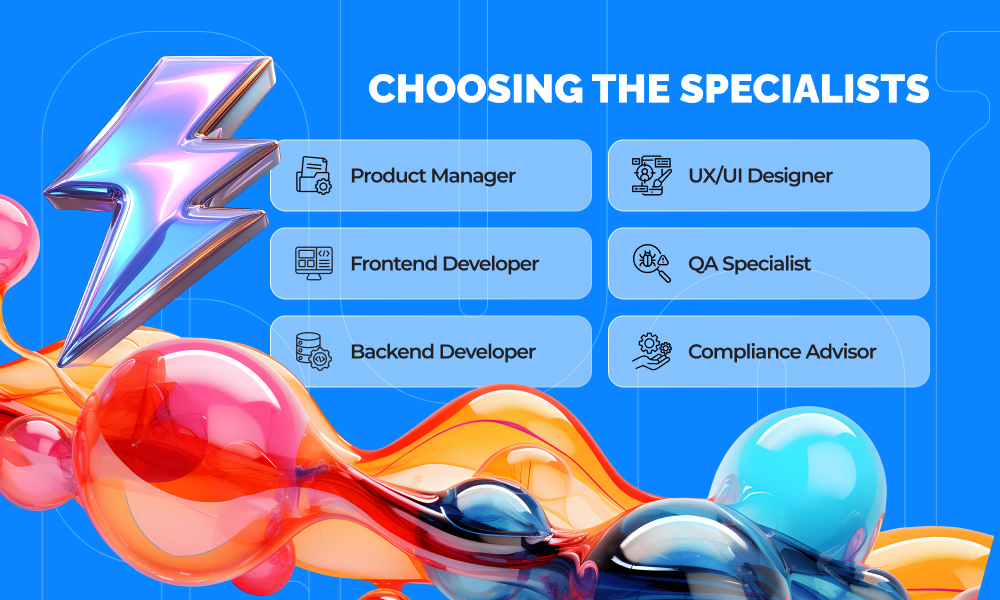
So, you need the following specialists to build your e-wallet MVP:
- Product Manager
Responsible for strategy, business goals, feature prioritization, and communication between stakeholders
- Backend Developer
Implements business logic, integration with blockchain, escrow systems, KYC, as well as API interaction with partners
- Frontend Developer
Creates a user interface, ensures adaptability and intuitiveness (onboarding and transaction processes are especially important)
- UX/UI Designer
Designs logical and inclusive interaction scenarios adapted to different audiences
- QA Specialist
Responsible for stability and security and conducts functional and load testing, including eKYC flow and money transfers
- Compliance Advisor
Ensures product compliance with regulatory requirements (AML, PSD2, GDPR, etc.), prepares legal documents
A Technology Stack: What Powers Your Digital Wallet MVP
In addition to the experienced and powerful development team, you need to choose the right technologies for your future digital wallet. Don’t repeat the mistakes of 70% of fintech startups that didn’t take this issue seriously. Let’s see what tools will help you create a secure and reliable solution in a short time.
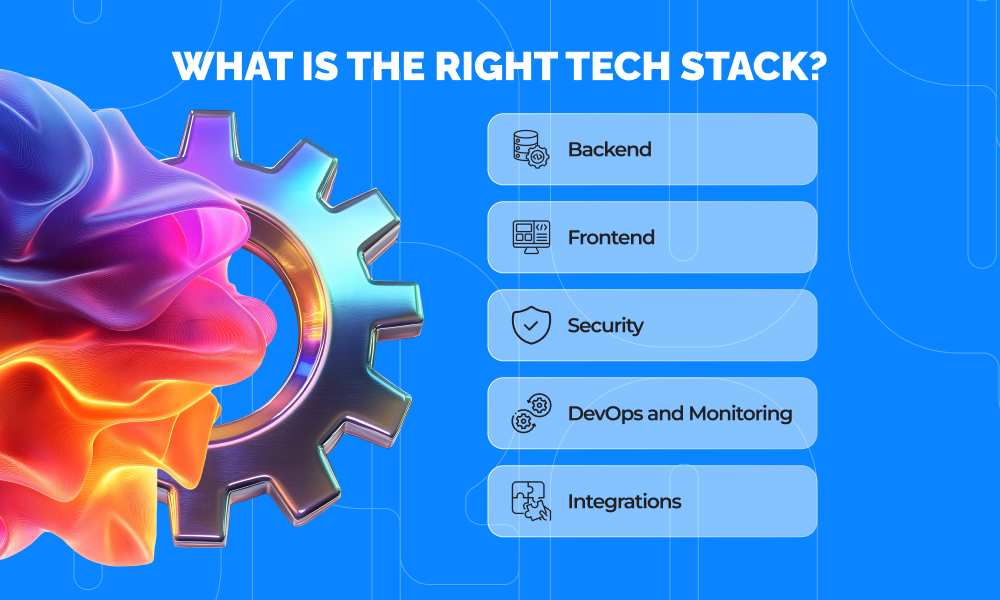
Backend: Reliability and Scalability
- Programming languages: Go, Node.js or Java that provide high performance and low latency, especially in a microservice architecture
- Frameworks: Gin (Go), Express (Node.js), Spring Boot (Java) that allow you to quickly deploy a RESTful API with built-in security
- Databases: PostgreSQL for transactional reliability, Redis for caching and processing temporary data
- Architecture: Microservices + API-first approach that simplifies scaling and integration with external systems
Frontend: Adaptivity and UX
- Frameworks: React or Vue.js that provide interface flexibility and fast development
- Mobile version: React Native or Flutter that allow you to create a cross-platform application with a single code
- UI libraries: Tailwind or Material UI that speed up the development process and provide visual consistency
Security: Data Protection and Regulatory Compliance
- Authorization: OAuth 2.0 + JWT, a standard for secure authentication and session management
- Encryption: TLS 1.3, AES-256, field-level encryption to protect sensitive data
- Compliance tools: built-in KYC/AML modules (Sumsub, Onfido), action logging (audit trails), attack protection (rate limiting, IP throttling)
DevOps and Monitoring: Stability and Control
- Containerization: Docker + Kubernetes for scalable and manageable deployment
- CI/CD: GitHub Actions, GitLab CI that are used for test and release automation
- Monitoring: Prometheus + Grafana, Sentry that are used for error, performance, and user scenario tracking.
Integrations: Payment Gateways and External APIs
- Payment systems: Stripe, Payoneer, crypto providers (e.g. Fireblocks or Coinbase Commerce)
- Analytics: Mixpanel, Amplitude for tracking behavior and optimizing UX
- Communications: Twilio, SendGrid for notifications and confirmations
Bottom Line
So, we’ve told you about the key elements of creating a digital wallet, from the timeline and team composition to the tech stack. You have a clear idea of how to create a digital wallet MVP in 10 weeks. This is quite possible when you have the right strategy, a well-coordinated team, and verified instruments.
An MVP should solve a specific problem, be secure, intuitive, and ready for scaling. And the team is not just performers but product partners who are able to adapt, synchronize, and bring the idea to the market. If you are planning a launch, don’t focus on the ideal result. Your goal is a quick, viable start that will provide real data, user trust, and a basis for growth.
If you have any questions (technical, strategic, or just “where to start?”), don’t hesitate to contact us. Whether it is a short request or a complex task, we will help you understand, structure, and find the best solution.

Related Articles
Mastering AI Prompts: A Guide to Writing Effectively with Little Pain

Artificial Intelligence in the Hospitality Industry: Service at Its Smartest

Unleashing the Power of AI Outsourcing: Your Ultimate Guide!

Contacts

Contacts
Thank you, !
Thank you for contacting us!
We’ll be in touch shortly.
Feel free to get in touch with us! Use this contact form for an ASAP response.
Call us at +44 151 528 8015
E-mail us at request@qulix.com


Thank you!
Thank you for contacting us!
We’ll be in touch shortly.
Feel free to get in touch with us! Use this contact form for an ASAP response.
Call us at +44 151 528 8015
E-mail us at request@qulix.com


