Congratulations — you did it. The regulatory hurdles are behind you, and your business is now officially a licensed Electronic Money Institution (EMI). Take a moment to bask in that success… because now the real work begins.
The regulators reviewed and accepted your governance model, risk controls, policies, and, very likely, even the basic product prototype alongside systems architecture. But it is time to prove you can navigate the harsh waters of fintech — and launch a functional payment system live in a real-money context.
But how can you be sure your MVP is truly ready?
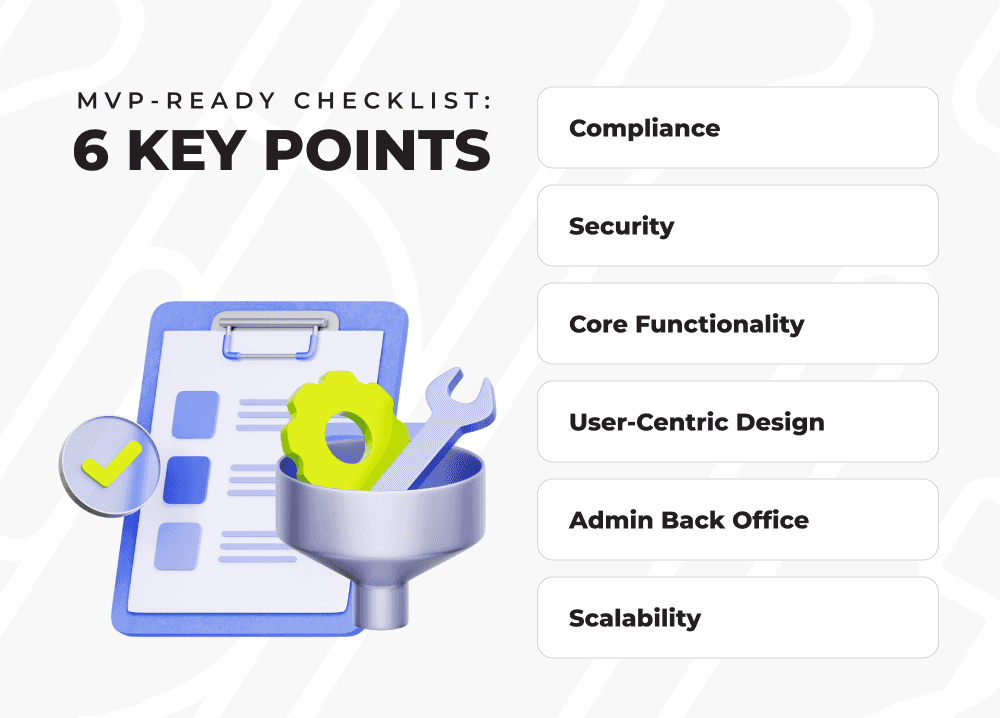
To help you ease the launch anxiety, we’ve compiled a checklist with 6 hallmarks of a winning MVP. Interested? Then keep reading.
#1. Compliance
Any product launch is a serious matter — but in the world of fintech, the stakes are especially high: you’re dealing with other people’s money. An EMI license, in particular, allows its holder to issue electronic money, offer prepaid cards, and provide mobile payments. If you fail to meet stakeholder expectations, the reputational damage and financial fallout can be severe.
According to Grand View Research, the global fintech market is projected to reach $949.49 billion by 2030. However, a new study found that a staggering of 73% of fintech startups fail due to — drum roll — regulatory compliances.
Yes, the battle for compliance continues even after the EMI license has been obtained. Which is why it is vital not to perceive compliance as:
What does it all mean?
Compliance reflects your understanding of how all components of your product work together — continuously. KYC, AML, risk assessments, payments and transaction monitoring, governance — it’s not enough to tackle just one issue. If something is lacking in adherence to regulations, then the overall vulnerability of your solution begins to surge.
Another common mistake businesses make is concentrating on technical excellence. They forget that it neither addresses the full scope of aspects concerning the launch and operation of a solution, nor does it substitute human roles in product development. In other words, no matter how advanced, technology is not a compliance professional who knows the challenges, the risks, and the pitfalls of putting a fintech application out there. The most refined feature set cannot replace a deep understanding of the strict rules your functionality must operate within. Equally, it is not capable of developing a compliance strategy and making appropriate decisions.
Compliance has to be your focal point for as long as you intend to keep your fintech product running. And to withstand the pressure from regulators, from the MVP stage onward, you have to partner up with a compliance officer. They will help you deal with KYC/AML flows, GDPR compliance, audit trails & logging of user activity, and transaction monitoring.
Getting a handle on compliance with the help of a professional is the first step in preparing your minimum viable product to face the market. And moving forward, that becomes your competitive advantage.
#2. Security
From the moment users register on your platform to how they interact with it over time — including workflows on the admin side — security standards must reflect your commitment to compliance. According to the Consumer Digital Trust Index by Thales Group, 87% of consumers expect basic levels of data privacy to be met. In other words, your MVP has to demonstrate a bulletproof front-end, a superior back-end, and top-of-line data storing and computing infrastructure.
What does this mean in practice?
Beyond customer-facing features, what else should you prioritize?
#3. Core Functionality
What is the purpose of the MVP? First and foremost, it’s a learning tool. You get to discover more about your customers, their needs and expectations — you also find out more about your solution and what is hidden behind the curtain of the market. But don’t let the simplicity of the MVP concept mislead you — it’s not an inferior product. This simplicity is exactly where brilliance lies: extract maximum insight with minimum effort.
One or two core features is all you require at this stage. But this functionality has to be executed flawlessly and, most importantly, address a specific problem your target audience faces. That’s how you prove your value proposition and build a product that can be marketed, gain traction, and generate revenue.
So what’s your focus? Is it e-money issuing and distribution? Topping up and withdrawing cash from a payment account? Money transfers — domestic, international, or both? Currency exchanges? Whatever your main use case is, refine it and hone the surrounding details, like account creation, onboarding, push notifications, etc.
#4. User-Centric Design
It might seem like dedicating time and money to the development of a design concept at the MVP stage is excessive and can wait: after all, you’ve got other priorities. But we are here to convince you that you need a thought-through UI and UX just as much as your target audience does. Fonts, colors, buttons, navigation — all these elements are key to your success, and here is why.
What can a design concept do for you?
What to implement in an MVP?
We hope you’re now convinced that UI and UX design deserves your special attention — even this early in development. We recommend focusing on these key aspects:
If you need help testing your solution across devices, let us know. We provide mobile configuration testing services and would be glad to assist you.
#5. Admin Back Office
Operational visibility is critical — not only for regulators who need assurance that you’re in control of the inner workings of your system, but also for your team to manage the application effectively.
From the MVP stage onward, your admin portal has to include these essential capabilities:
#6. Scalability
This one isn’t so much about regulators — it’s about you. MVP isn’t your final product, but it is a foundation meant to support your expansion. To make that happen, you need to plant the right seeds from the start.
Qulix advises: if you want your product to grow in step with your ambition, invest in:
Ready? Go!
Fintech development is no walk in the park — but neither was obtaining your EMI license. Still, you did it. And you know that if you lay the groundwork, you can launch your MVP within a couple of months — and do it with confidence.
A Qulix pro tip? Partnering with a reliable tech vendor is always a smart move. You’ll gain the expertise and experience your in-house team might be missing — and avoid common pitfalls that often trip up newcomers in the fintech space.
As for that role, we gladly recommend ourselves: we’ve been in the game for 25 years and have delivered numerous financial projects for major clients.
If you’re ready to talk to a seasoned team of fintech developers, contact us — we’d be happy to schedule a free consultation and discuss your project. Let’s make it happen.
Related articles
About the Author