Digital wallets are one of the fastest-growing segments of fintech. The global e-wallet market is expected to reach $3 trillion by 2029, reflecting the rapid growth of digital payments worldwide. It’s no wonder that the financial industry demands flexible, secure, and convenient solutions. Therefore, the best idea is to launch an MVP that allows founders to test the product in practice, collect user feedback, and make the necessary improvements.
In this article, we will talk about the key mistakes that businesses make when creating a digital wallet MVP and offer practical ways to avoid them.
What Mistakes Do Companies Make When Creating a Digital Wallet MVP?
Founders should pay close attention to building an e-wallet MVP, as the future of the product depends on it, especially in fintech, where trust, security, and convenience are critical from the first seconds. However, in an effort to release the solution faster or show superior features, you often lose focus and miss the main thing — your MVP should test an idea rather than demonstrate ambitions. Below are the most common mistakes that prevent your digital wallet MVP from fulfilling its real task.
Mistake 1: Your MVP Doesn't Have a Real Use Case
Businesses often try to create a mobile wallet that can do everything. But you must remember that the purpose of an MVP is not to demonstrate your ambitions. It should test an idea. If an MVP does not solve a specific problem for a specific user, it is pointless.
How to avoid:
Mistake 2: Ignoring Regulatory Requirements
Digital wallets are not just an interface. They are a financial instrument subject to laws. Many businesses launch MVPs without taking into account KYC/AML, licensing, and data protection requirements.
How to avoid:
Mistake 3: An MVP That Can't Be Monetized
Some MVPs look nice but have no business model. You can add a lot of attractive features, such as free transfers, no fees, no partner integrations, and others. It’s cool but not sustainable.
How to avoid:
Mistake 4: Rebuilding a Banking System from Scratch
A digital wallet is not a bank. But many businesses try to build an architecture like a bank, implementing complex databases, proprietary payment gateways, custom security protocols, and so on.
How to avoid:
Mistake 5: An MVP Aren’t Tested With Real Users
MVPs are often created in a vacuum when the development team tests the product by itself, without involving external users. As a result, they get an interface that no one understands and features that no one needs.
How to avoid:
Mistake 6: Your Digital Wallet MVP Doesn’t Use Analytics
If you don’t know how users interact with the app, you won’t be able to improve it. The lack of built-in analytics is one of the most common mistakes.
How to avoid:
Mistake 7: Your MVP Has Too Many Features
Digital wallets can do many things, such as store cards, send cryptocurrency, accrue cashback, integrate with banks, and so on. When you try to create a lot of features, you can forget that your MVP should do one thing well.
How to avoid:
Mistake 8: Your MVP Doesn’t Have a Clear Value
If users don’t understand why they need your mobile wallet, they won’t use it. “We have a beautiful design” is not a value. “We work with cryptocurrency” is not a value. Value is the ability to solve a user’s problem.
How to avoid:
Mistake 9: You’ve Chosen the Wrong Development Team
Fintech is not just code. It is security, user experience, integrations, regulations, and more. The team that makes e-commerce apps may not be able to handle a digital wallet.
How to avoid:
Mistake 10: Your MVP Doesn’t Have a Scaling Strategy
Even if your MVP is successful, it can break when growing because the architecture can’t handle it, security doesn’t scale, and the business model doesn’t work at high volume.
How to avoid:
Mistake 11: An MVP That Tries to Be Perfect
The desire to make a perfect MVP leads to protracted development, team burnout, and loss of focus. Your MVP should be fast, useful, and open to different reviews.
How to avoid:
Mistake 12: A Digital Wallet MVP Without a Clear Goal
If the team doesn’t know what they want to test, a mobile wallet MVP turns into a meaningless product. The goal can be different, like checking demand, testing user experience, evaluating willingness to pay, and so on.
How to avoid:
Let Qulix Create a Digital Wallet MVP for You
We have been working in fintech for over 20 years and know how to create an MVP properly. Our specialists will take on the entire development cycle and help you avoid common mistakes. What we can do for you:
Last Word
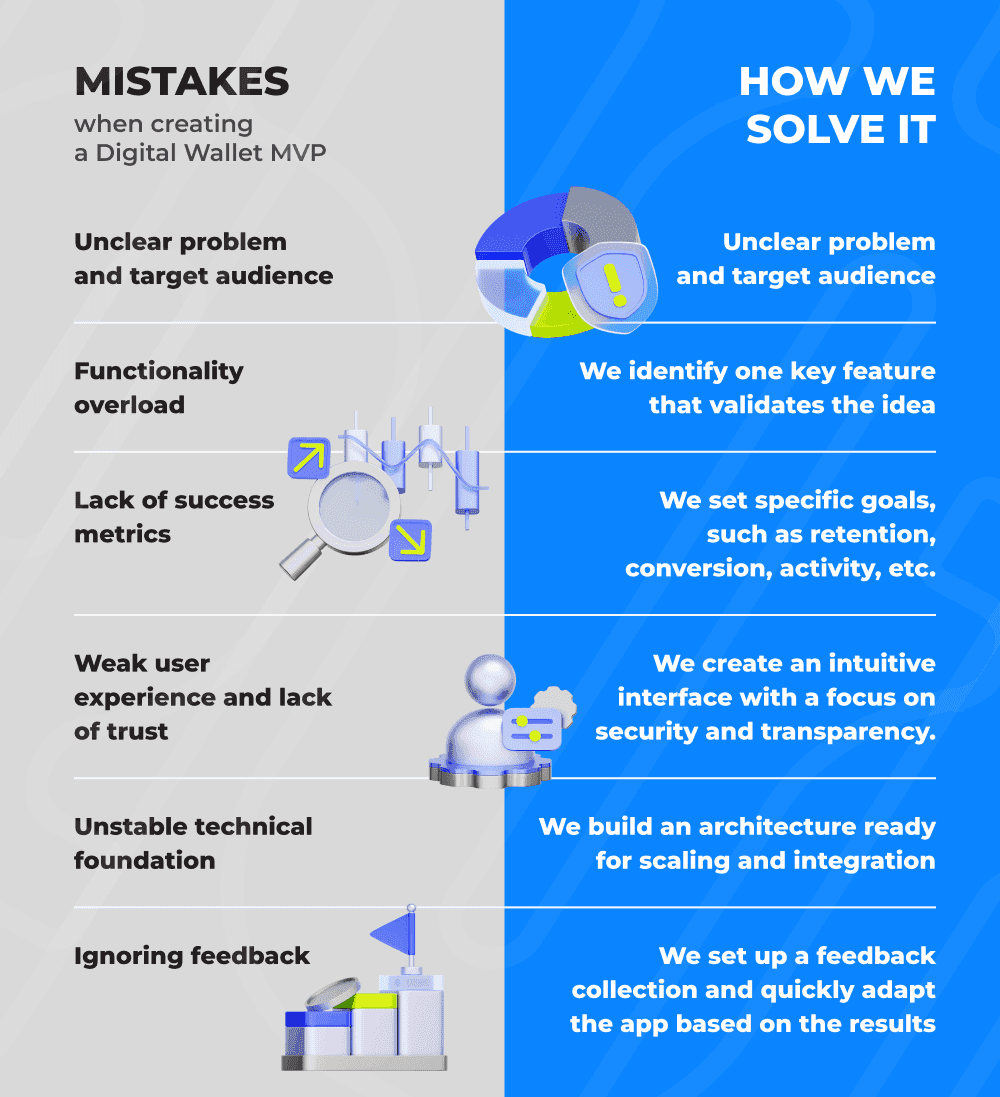
Creating a mobile wallet MVP is not an attempt to do everything at once. It’s a way to quickly check if your idea works. In fintech, it’s especially important to be fast, flexible, and attentive to details, from user experience to compliance. If you avoid these mistakes, your MVP will become not just a prototype but the foundation for a scalable, in-demand, and profitable product.
Ready to discuss your idea? Contact us right now!
Related articles
About the Author