As the world witnesses more technological innovation, employees and customers wrestle with more complex challenges. Mobile, fixed, and cable company staff deal with a flood of inquiries from various channels. They must match the right clues to customer requests quickly and empathetically, as their paychecks depend on it. Meanwhile, corporate teams at HQ grapple with unstructured data, seeking hidden insights.
Feeling the pressure? How can you adapt to deliver a hassle-free yet innovative experience for your team and clients? Could the adoption of AI in telecom become the solution to telecom challenges? Let's find the answers in today's article!
Current State of AI in the Telecommunication Market
The telecom industry is no stranger to sharp technological advances. We’re witnessing the push towards innovation with AI taking center stage. The primary driver? The need to stay competitive and cater to the shifting demands of telecom operators and their customers.
The industry used to seem like an impenetrable fortress, rarely undergoing renovation. Connectivity, internet, and mobile reception were the mainstays. Periodic speed upgrades from 4G to 5G marked the extent of innovation. This approach sufficed for a while. But with AI’s arrival, everything has changed.
Today, telecom operators need to broaden their range of services. They should adapt packages for each customer, introducing targeted solutions for specific segments. Exceptional and personalized customer service has become the hallmark of any reputable telco. Advanced networking hardware and efficient network management are key to this transformation.
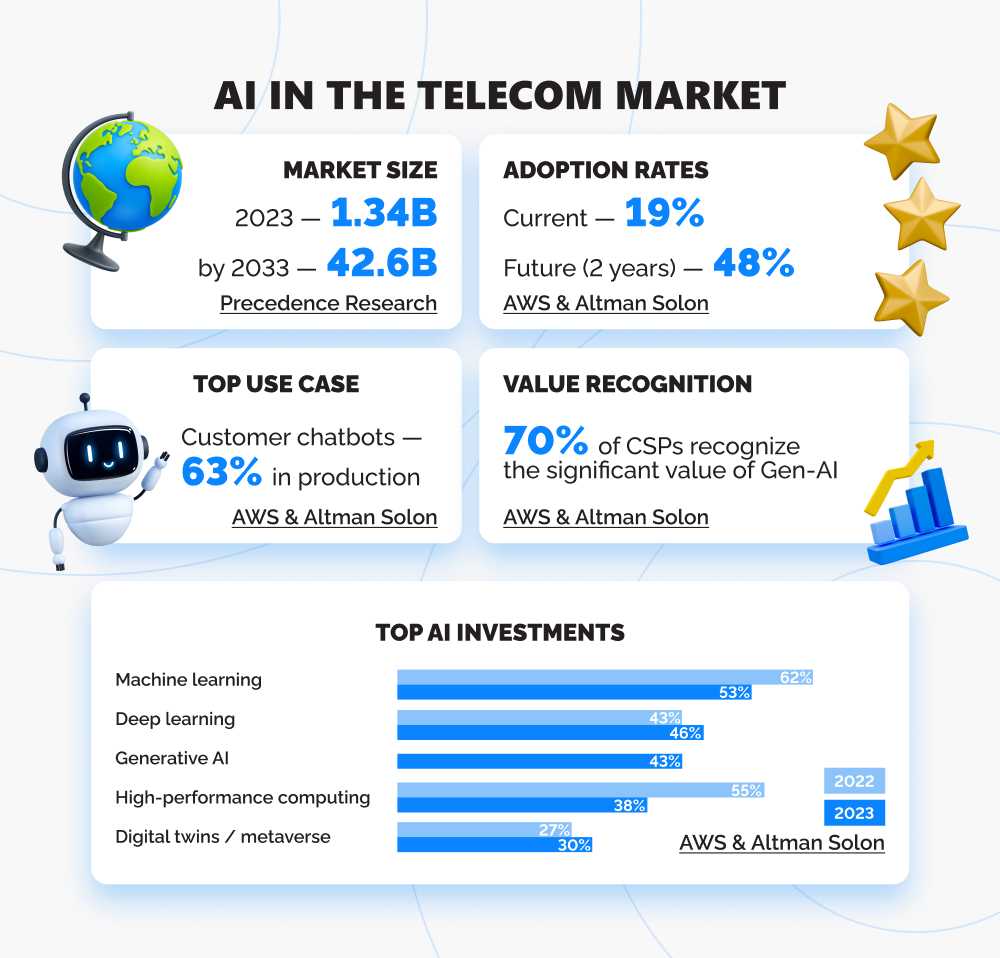
How’s the adaptation going? Let's explore the current state and key prospects for artificial intelligence in the telecommunication market:
AI in Telecom: Challenges to Solve
The future of AI in the telecom industry looks promising. This field has amassed mature data with many challenges. Yet, the latest developments can effectively combat them. Investing in AI can turn these obstacles into growth and innovation opportunities. Let's take a broader perspective on the key telecom challenges that AI solutions can solve.
Challenge #1: High Maintenance Costs
McKinsey notes that field and service operations occupy a large part of carriers’ operating budgets — between 60% and 70%. The reason?
Telecom companies manage a wild range of hardware. Routers, gateways, switches — every piece of equipment is integral to network functionality. But each calls for constant monitoring to prevent failures. High-quality service demands regular updates, troubleshooting, and replacing outdated or faulty components.
The flip side is the complexity and scope of these tasks. They demand significant financial investment and manpower. The result is immense operational costs that can strain budgets.
What adds to the financial burden? The rapid pace of technological advancement. As new technologies emerge, telecom companies must modernize their infrastructure to stay competitive. This entails purchasing new hardware and integrating it into the existing network. Neglecting this results in more frequent breakdowns in legacy systems, escalating maintenance costs.
The geographical spread of telecom infrastructure adds another layer of complexity. Networks often cover vast areas, including remote and difficult-to-access locations. This demands a dispersed maintenance team and precise planning for timely upkeep. What does this mean for you? That’s right, more expenses.
Challenge #2: Managing Big Data
In the telecommunications industry, data is among the most valuable assets. Yet, the practical value of this information rests on how you wield it and what insights you glean from it.
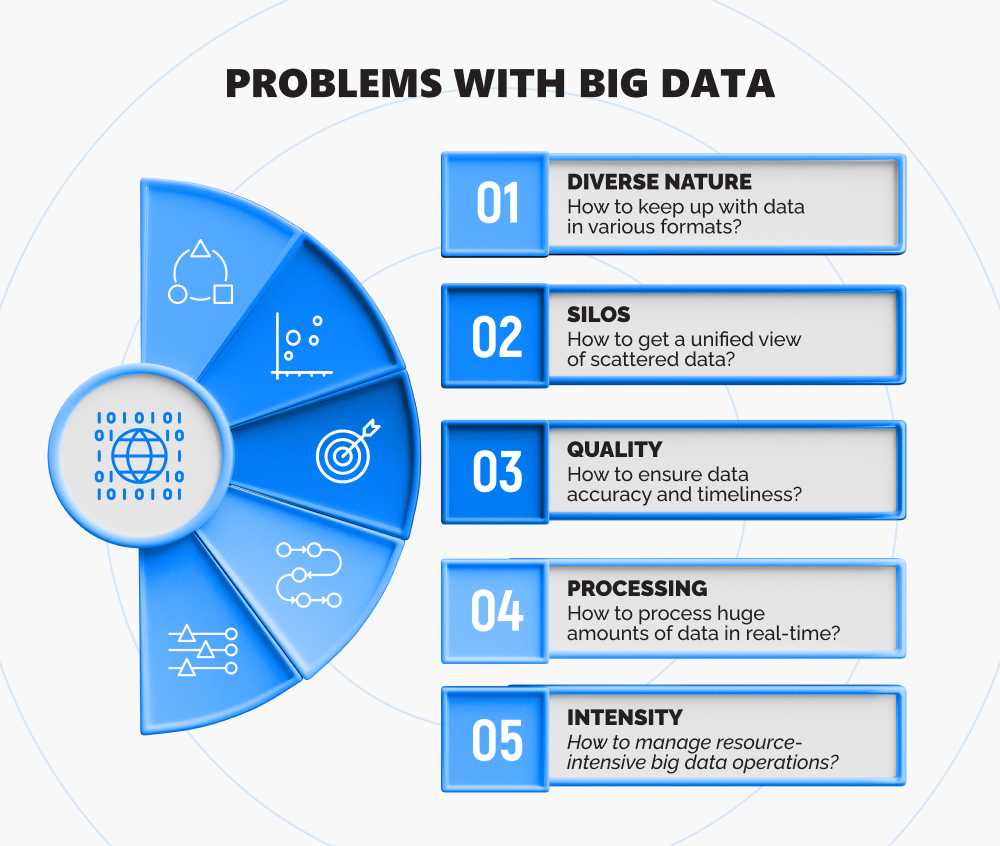
Telcos store big data. This includes network activity, operational data, customer information, device details, and location data. With so many users and constant data generation, the amount of information is mind-boggling.
What’s the problem with big data besides its sheer volume?
Challenge #3: Insufficient Response to Customer Pains
When everyone and everything is connected, even a minor glitch can become a nightmare for a telecom company. If connectivity fails, users flood service providers with their grievances. As user numbers and requests grow, customer service quality drops. This leads to long waits, unresolved issues, and impersonal interactions.
Customers want fast, efficient service. But telecom companies struggle to meet these expectations due to high call volumes and limited resources. Long wait times breed frustration, and unresolved queries undermine trust and loyalty. This impacts customer satisfaction and tarnishes the company's reputation.
Impersonal interactions are a big problem in telecom, where personal touch matters. Customers often feel like just another number in the queue, not valued clients. Repeated failed interactions lead to a disconnect between the company and its customers, worsening dissatisfaction.
Statistics back this up. According to Zendesk, about 80% of customers would rather do business with a competitor after more than one bad experience.
Challenge #4: Security and Data Leakage
Telecom fraud is a grave and evolving challenge for the industry, driven by rapidly advancing technology and sophisticated fraud techniques. Forbes reports that global revenue losses from criminal activity have reached 2.2%, or $40B.
Here are some of the major threats telecom providers have to fight:
Why do these situations persist in telecom?
Benefits of AI in Telco
Do any of the obstacles listed above relate to your situation? Even if you're lucky enough to avoid them, taking precautions is always wise. Consider AI applications that promise to help you overcome or prevent these problems.
Efficient Network Management
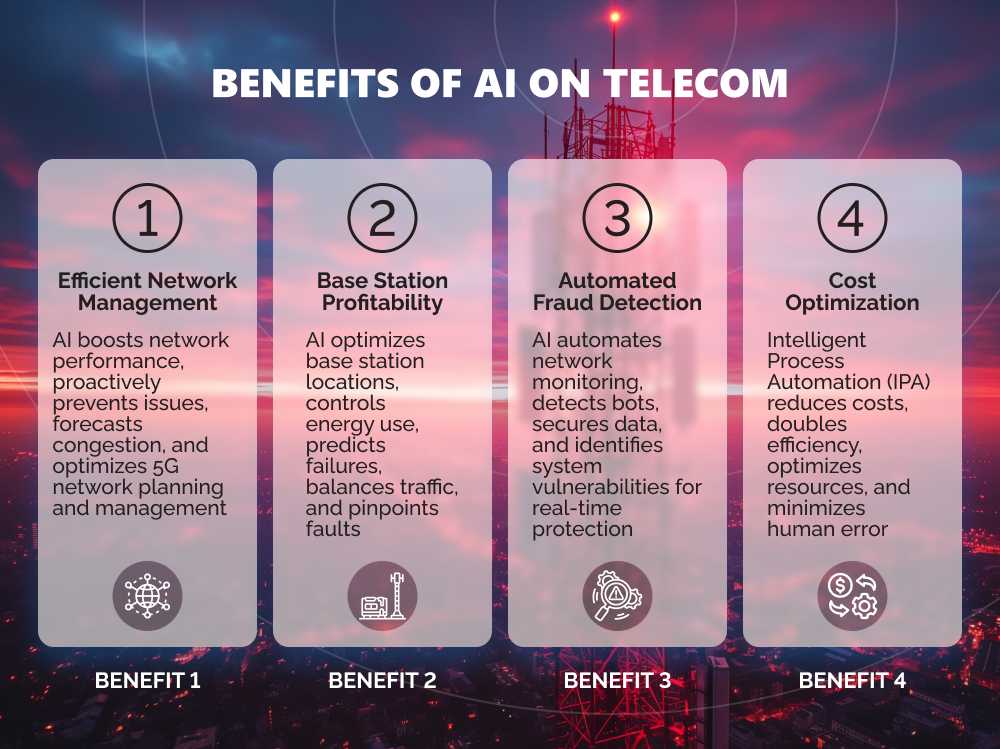
Adopting AI for network management equips the telecommunications sector with powerful tools to improve network performance and proactively troubleshoot emerging issues. Advanced AI algorithms help communications service providers (CSPs) detect and predict network anomalies before they affect customers.
For instance, a well-built AI system can forecast congestion by analyzing network traffic patterns across regions and time zones. This allows CSPs to reroute traffic in advance and prevent outages.
A prime example of AI's potential is in 5G network planning and management. Since its rollout began in 2019, 5G aimed to cover about 80% of the world's population by 2029 (ericsson.com). Artificial intelligence in telecom can assist in building self-optimizing networks (SONs) that adapt to changing conditions and demands. Thus, it will contribute to the rapid growth and complexity of 5G infrastructure.
Profitability of Base Stations
Aside from new technologies, the industry is experiencing a strong demand for high-speed mobile data services and the rapid expansion of mobile networks. This calls for the early modernization of telecom base stations. The deployment of 5G technology has further increased the need to improve their capacity and coverage.
What is the crux of the problem? The high cost of base station equipment and the demand for properly trained specialists to deploy and maintain these systems. This is a perfect match for AI-based tools. How exactly they can help:
Recent news from Samsung illustrates these use cases. The company has introduced AI-RAN Parameter Recommender, which automatically recommends optimal parameters for each base station environment.
Automated Fraud Detection
Telecom fraud has plagued the industry since its inception. Fortunately, AI-enabled tools now help carriers stay ahead of evolving fraud schemes. They provide network automation and ongoing monitoring to detect bots, prevent unauthorized access to customer data, and safeguard sensitive information.
When combined with IoT, data analytics, and cloud computing, AI tools excel in real-time network monitoring. They quickly spot system vulnerabilities, allowing CSPs to patch them, update encryption, and improve data storage methods and disaster recovery plans. This approach minimizes financial loss, protects reputation, and guarantees compliance with legal standards.
Cost Optimization
All these benefits culminate in one advantage that every business values the most — cost reduction. That’s where Intelligent Process Automation (IPA) comes into play. IPA uses AI, machine learning, cognitive automation, and computer vision. With them, lengthy procedures — invoicing, order management, and data processing — run much faster.
By using these technologies for automation, telecom companies gain several benefits at once:
When AI automates repetitive tasks, optimizes resources, minimizes downtime, and predicts traffic anomalies, all you'll notice is lower operational costs and the desired profitability. Recent statistics only bolster these claims.
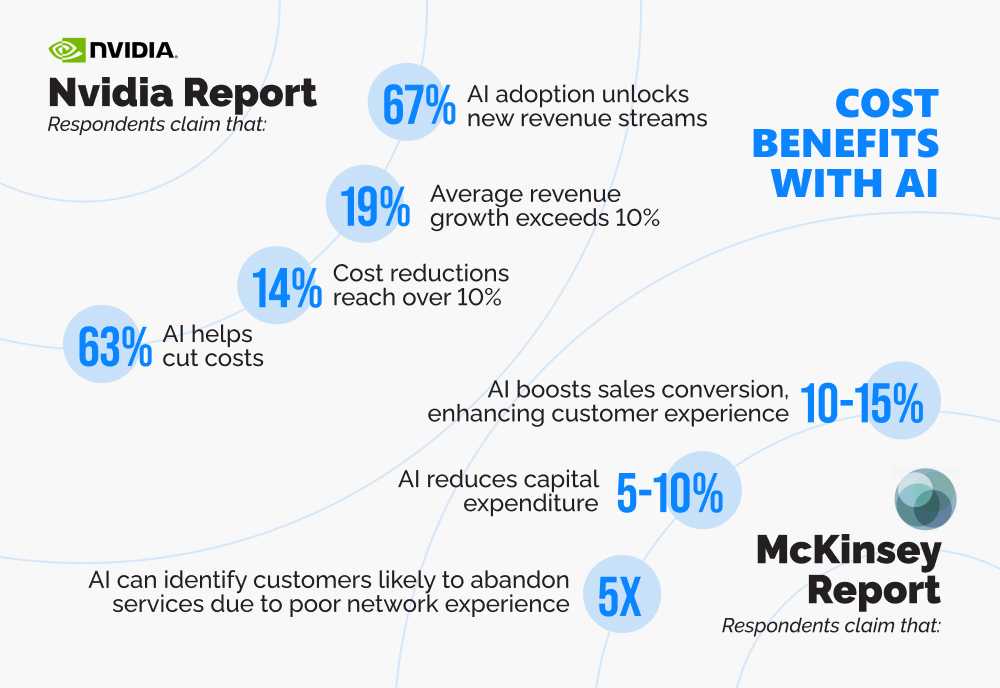
Nvidia report:
McKinsey report:
AI Use Cases in Telecom
The pros of technology are in place. Then it's time to explore what they yield in real life. Below is a table listing a few of the key global AI/ML use cases in telecom.
*What do you think about AI in the entertainment industry? Is it a good pair? Read more in our blog post.
Red Flags for AI in Telecoms
While technological complexity and workforce adoption may seem major obstacles in your AI journey, other aspects also require your attention. Let's explore the key factors for a successful and trouble-free AI implementation.
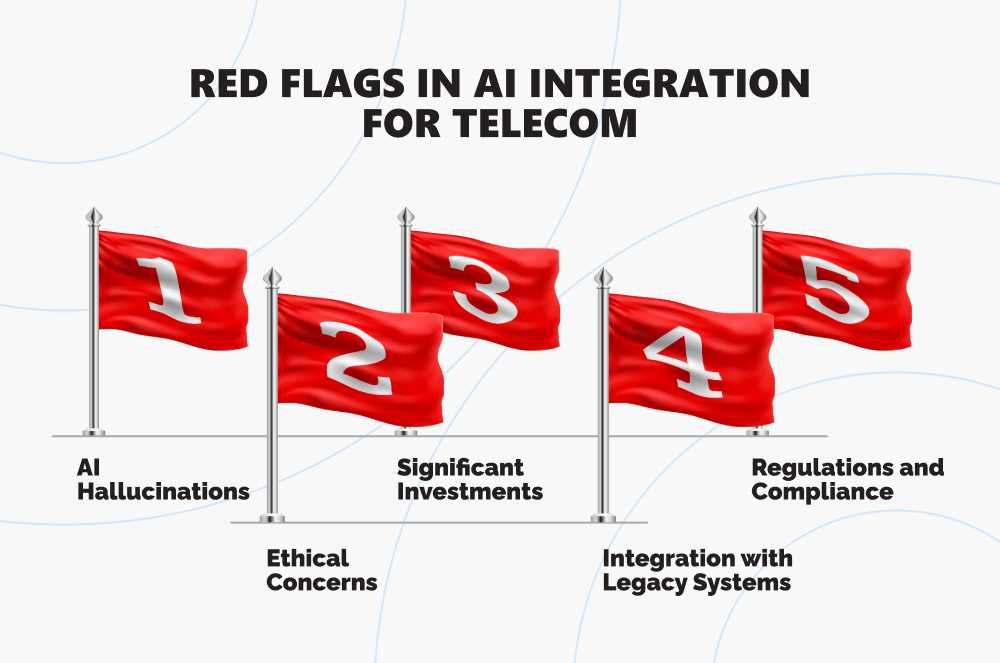
AI Hallucinations
These are incorrect or nonsensical outputs that generative AI produces. In 2024, the world has seen several notable slip-ups that AI hallucinations caused. In February, AirCanada was forced to cancel a mistaken discount offered by its chatbot. In May, Google revised its “AI Overviews” after its bot incorrectly claimed it was safe to eat rocks. In June, two lawyers were fined $5,000 after one of them admitted to using ChatGPT, which added fake citations to court documents.
While AI hallucinations tend to be infrequent, they are constant. The frequency rate ranges from units of percent (Vectara's Hughes Hallucination Evaluation Model) to tens (National Library of Medicine). The best strategy here is to not rely on AI 100% and always double-check what it states as a fact. Your company's reputation is at stake.
Ethical Concerns
Inclusivity, fairness, and bias concerns deserve special attention. Gen-AI, powered by machine learning algorithms, relies on data. If this data is low-quality, biased, or lacks inclusivity and ethics, your AI model may unintentionally perpetuate or amplify these issues.
To be ethical and avoid sensitive conflicts with users, you should check the information on which you train your LLM agent. By doing so, you will mitigate, if not avoid, misuse, abuse, hallucinations, and algorithmic bias.
Significant AI Investments and Tech Expertise
Adopting AI for telecom requires huge financial investments. As a telecom provider, you must decide whether to build your own AI model from scratch or to buy licenses for integration. Don't forget the time and money spent on finding experienced specialists and bringing them on board.
You'll have to choose an optimal route: get the necessary skills in-house by hiring more staff, or choose the outsourcing road and collaborate with a third-party vendor. Hiring and keeping professionals with AI expertise can be costly and competitive. As the hunger for smart technologies skyrockets, so does the price of talent. Companies must not only offer attractive packages but also create compelling environments to win over and retain these in-demand professionals.
Integration with Legacy Technologies
Even with technological advances, many network operators still rely on legacy systems. This further complicates AI integration. The process requires a separate strategy and significant changes to your IT architecture. The hassle of blending new AI technologies with legacy systems leads to compatibility issues, higher costs, and delays. Your team will master smooth data flow and maintain system stability during the transition. This takes careful planning and execution, translating to extra time and money.
Regulatory and Compliance Issues
As AI becomes more integrated into telecommunications, the focus on regulatory compliance intensifies. The Telecommunications Security Act 2021 in the UK, for example, sets strict requirements for telecom operators, including security measures and compliance monitoring. Navigating these regulations can be challenging, especially for companies outside their home country.
To stay compliant, you must understand the laws in the countries where you plan to offer AI services. Quickly adapting to new, evolving regulations will be equally beneficial. This may call for significant workflow changes, ongoing monitoring, and regular audits, which can drain resources and impact efficiency.
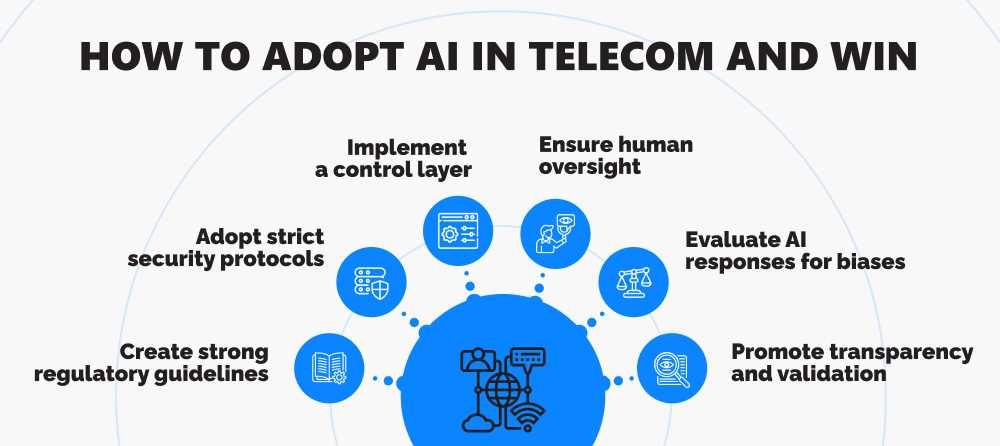
Telecom + AI: Success Stories from the Real World
Are you worried about the potential pitfalls of implementing AI? The telecom sector does have its share of challenges, but there's promising news. The industry is full of success stories where leading companies have successfully passed all the tests and are now thriving with AI. These are some compelling examples:
Are You Ready for Telecom’s New AI-Dentity?
Our today's exploration underscores the irreversible transformation within the telecom sector. It demonstrates that the role of AI in telecommunications is not an assistive technology, but an elevator lifting the entire industry upwards. Market leaders like Vodafone, Deutsche Telekom, and Orange S.A. exemplify how virtual assistants can address complex challenges, optimize operations, and drive better customer experience.
These success stories highlight the limitless potential of AI-driven telecommunications. The sector's adaptability and commitment to innovation set a precedent for other industries. All you need to ride this wave is the right technology partner to make your digital transformation smoother.
What do you think? Are you still not ready to transform your telecom business with AI? Qulix offers a suite of AI development services to guide your company through adopting the technology effectively. Contact us today for a smarter tomorrow.
Related articles
About the Author