Businesses are after AI assistants big time. They enhance productivity, increase customer satisfaction, save money, and improve lots of other things. 83% of firms claim that AI is their top priority, while 9 in 10 companies count on it to ensure a competitive advantage in the market (Exploding Topics). Even though AI comes in many shapes and forms, it’s the OpenAI’s invention, GPT, that continues to attract the public eye. GPT's lightning-fast evolution alongside its awe-inspiring capabilities make people go, “What if I integrate that into my company?”
In this article, we invite you to take an in-depth look at GPT-powered AI helpers. We’ll talk about the history of GPT, the way it operates with other AI technologies, and cover a few other peculiar topics. Let’s begin.
GPT Assistants: Where Did They Come From?
The 21st century is hard to imagine without AI assistants. Apple's Siri, AWS's Alexa and other virtual companions are tightly sewn into the canvas of our everyday and professional lives. In ten years, the gen AI market size is projected to reach $1.3 trillion (Bloomberg), and surely, GPT assistants are a major part of this picture. But before we find out how you can apply them, let's take a trip down memory lane and start with the most pivotal question: what in the world is GPT?
The Tale of GPT
New architecture & BERT
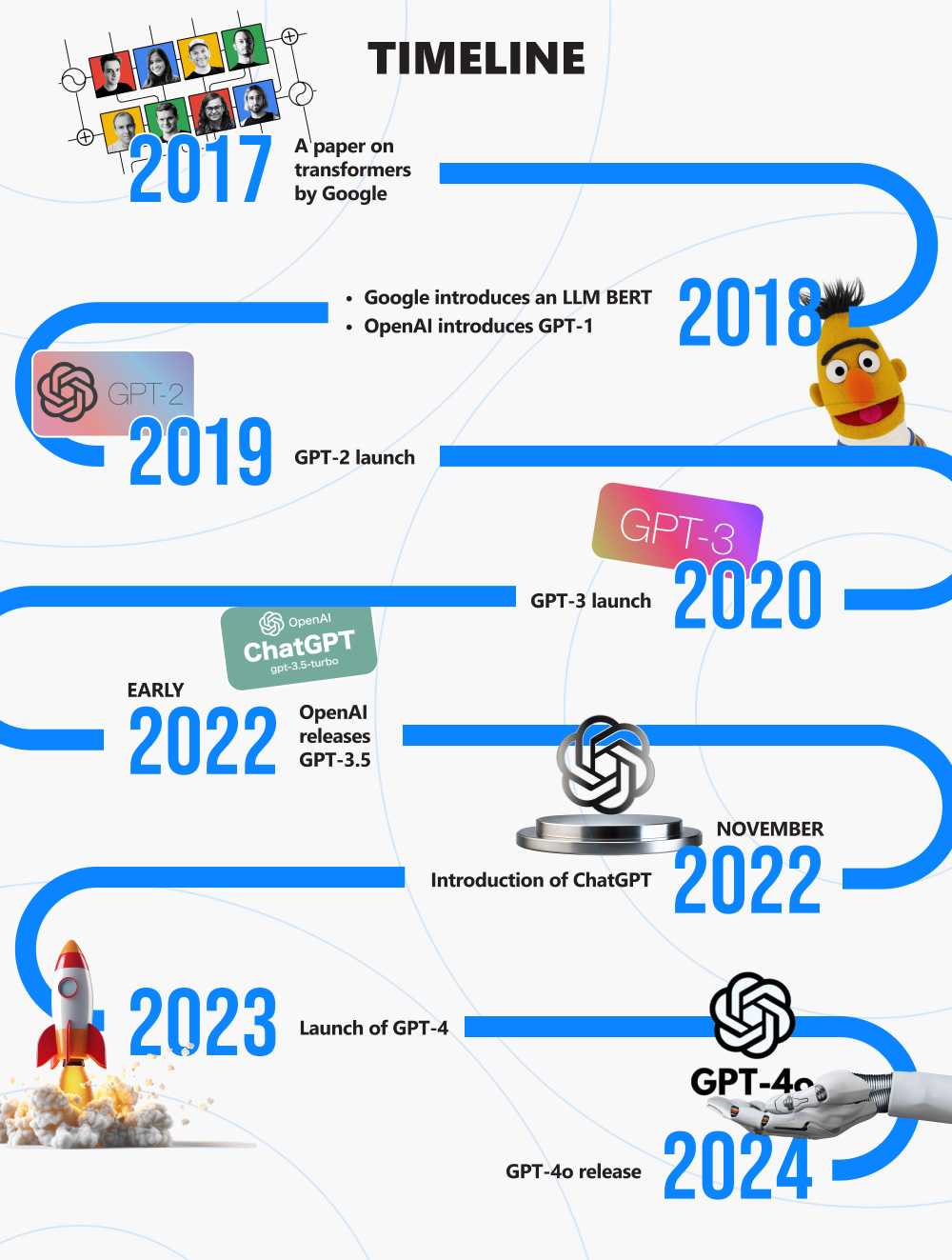
It's 2017, and Google researches publish a paper on transformers. This new architecture model, aka transformer neural network architecture, is about to redefine the field of natural language processing (NLP). The model's predecessors, i.e., recurrent neural networks, or RNNs, struggled with long-term dependencies due to issues like vanishing gradients. Models like Long Short-Term Memory (LSTM) and Gated Recurrent Units (GRU), i.e., advanced RNNs, were developed to alleviate them. Still, while they could handle context better than basic RNNs, they were not as effective as transformers. Transformers could recognize the context of words in a long sequence and maintain context in its responses.
In 2018, Google introduced their large language model (LLM) BERT, which put the paper theory to practice. It became clear that from now on, the training of AI models is going to be faster, simpler, and cheaper. Another thing that got illuminated with the emergence of BERT was the potential of large language models. Still, Google chose not to pursue it at the time, and it was OpenAI who stole the scene with a comprehensive application of the new technology.
Need a better understanding of LLMs? Click the link and enjoy the read.
GPT-1
In 2018, OpenAI introduces the first GPT model. GPTs stand for generative pre-trained transformers. The technology applied unsupervised learning, meaning machine learning algorithms can learn from unlabeled data with no pre-existing labels or categories defined by “supervisors”.
GPT-2
In 2019, OpenAI introduced GPT-2.
GPT-3
June 2020 was the beginning of a new era for GPT models. GPT-3 was trained on 570+ GB of text data (including BookCorpus and Wikipedia) and had 175 billion parameters. The model could tackle tasks that were way out of reach for its predecessors.
GPT-3.5 and ChatGPT
In early 2022, OpenAI finished training GPT-3.5.
GPT-4
OpenAI released GPT-4 in March 2023.
In May 2024, OpenAI launched GPT-4o, which marked “a step towards much more natural human-computer interaction”. Its inputs and outputs might consist of any combination of text, audio, image, and video.
GPT Assistants, ChatGPT, Assistant API: the Bottom Line
Now that we know what GPT is as well as all about its evolution, let's circle back to GPT assistants.
GPT assistants are specialized assistants, or applications, built on top of GPT models. People can interact with them using natural language.
While ChatGPT is a general-purpose conversational assistant, GPT assistants were designed to be placed within third-party applications via OpenAI’s Assistant API and aimed at performing specific tasks. Still, the ChatGPT interface might be viewed as a user-facing example of a GPT assistant.
At this time, the Assistants API supports three types of tools that can be accessed and used in parallel: code interpreter, file search, and function calling. These capabilities make it possible for GPT assistants to complete complex, multistep tasks, and be of great help in a variety of scenarios, from technical issues to dealing with business processes.
If you don't have coding skills and just want to see what a GPT assistant is capable of, you can visit OpenAI Playground to build one. The platform is perfect for prototyping and literally playing around with prompts, settings, and ways to apply the product before the launch. But for everything above that, coding skills are a must.
Need a hand? Qulix engineers have extensive expertise in AI. Contact us to schedule a meeting and discuss custom GPT assistants that can transform your business.
Custom GPT vs. Assistant
In case you suddenly get confused by these two, here's a quick note on how to distinguish them.
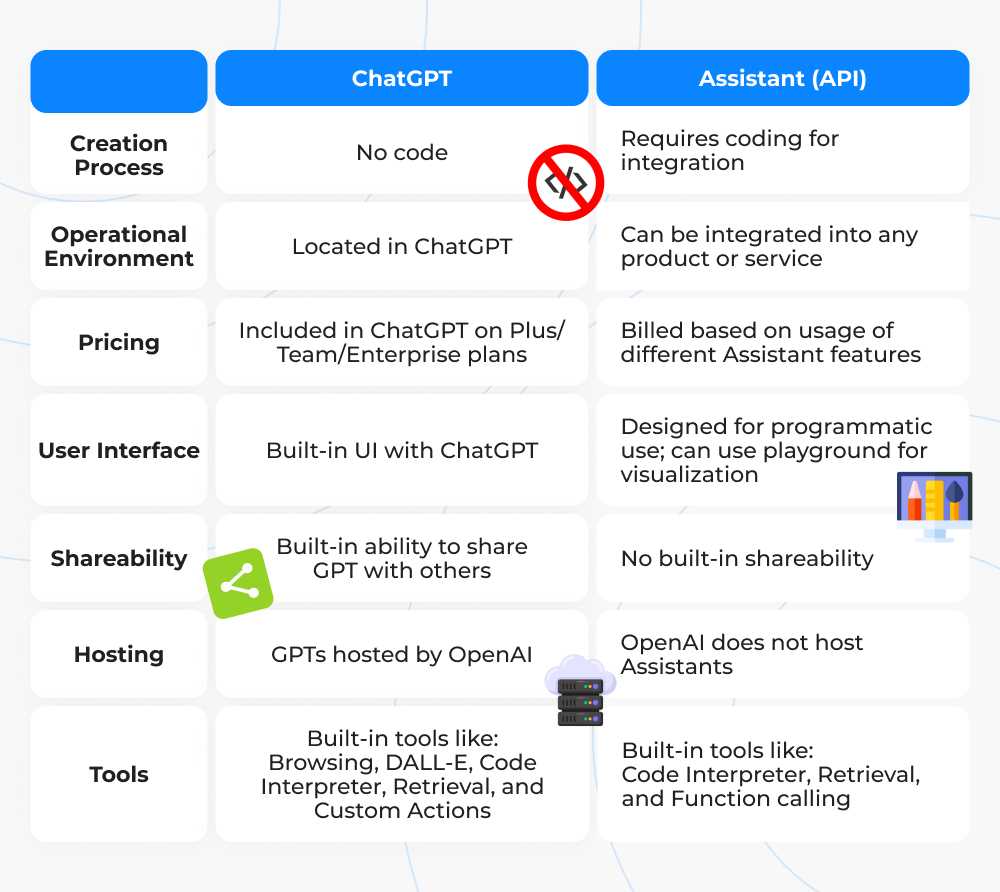
GPTs are custom versions of the ChatGPT platform, and you can build and tailor them for specific purposes within that environment by prompting the GPT Builder. The Assistant API offers to develop virtual helpers, like GPT assistants, inside your own app. As OpenAI puts it, “The main difference is that custom GPTs can generate the required instructions through conversation with the GPT owner, whereas for Assistants the instructions should come directly from the creators.”
For more information, check out the infographics below (OpenAI).
In What Business Areas Can You Apply GPT Assistants?
A modern day GPT assistant powered by GPT-4 offers benefits like scalability and consistency. The scalability refers to the model's ability to handle multiple interactions simultaneously, without the limitation by neither time nor capacity. The consistency is all about maintaining the tone of voice that matches the values of your business. While flesh-and-blood employees, no matter how professional, might uphold the standards differently since they're, well, people, an AI tool will preserve the same tone of voice.
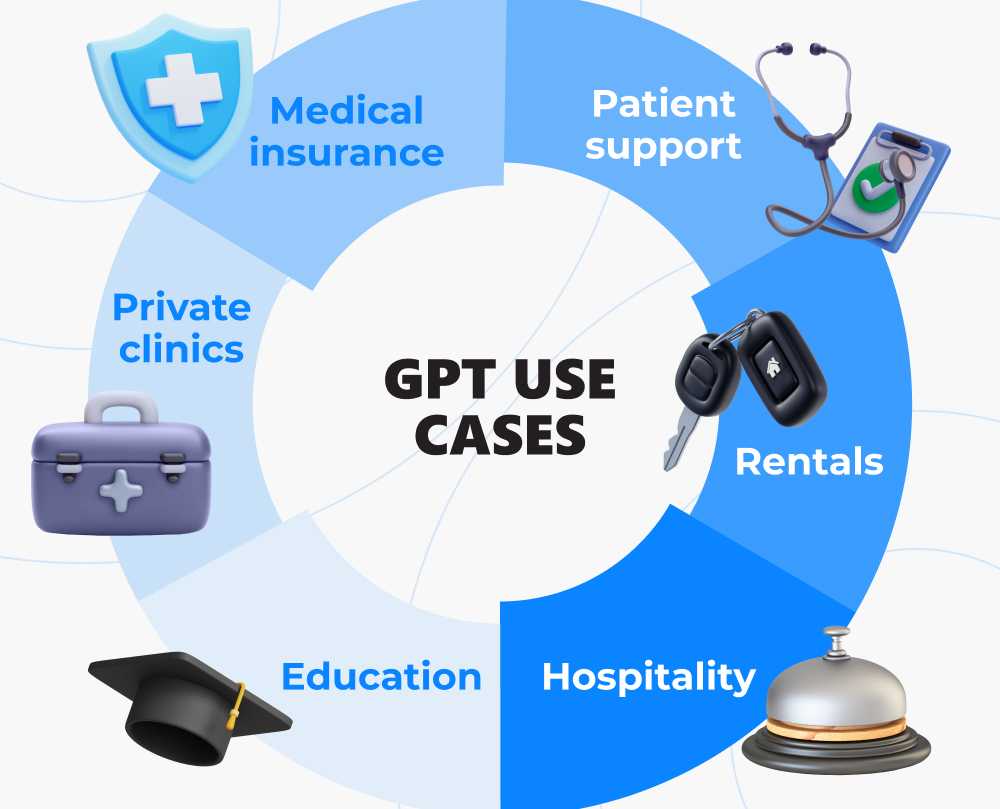
Combined, these two advantages of GPT assistants make them perfect for anything related to interactions with humans and personalized customer experiences. Hence, many business fields use these virtual helpers to elevate client support and boost efficiency.
AI is a big deal in hospitality. Want to find out how exactly businesses are applying it as you're reading this? Check out the article.
Integrating GPT Assistants with Other AI Technologies: What’s Possible?
#1. Data analysis
Airbnb, a rental giant, produces around 20 TB of data daily and stores about 1.4 petabytes of archived data. The company serves approximately 10 million requests per day and processes a million search queries. Doing all that with a small data science team isn't realistic, which is why technology had to be brought in. This drove the company to establish a whole AI ecosystem that handles personalization, recommendations, customer support, fraud detection, and other tasks (Venture Beat).
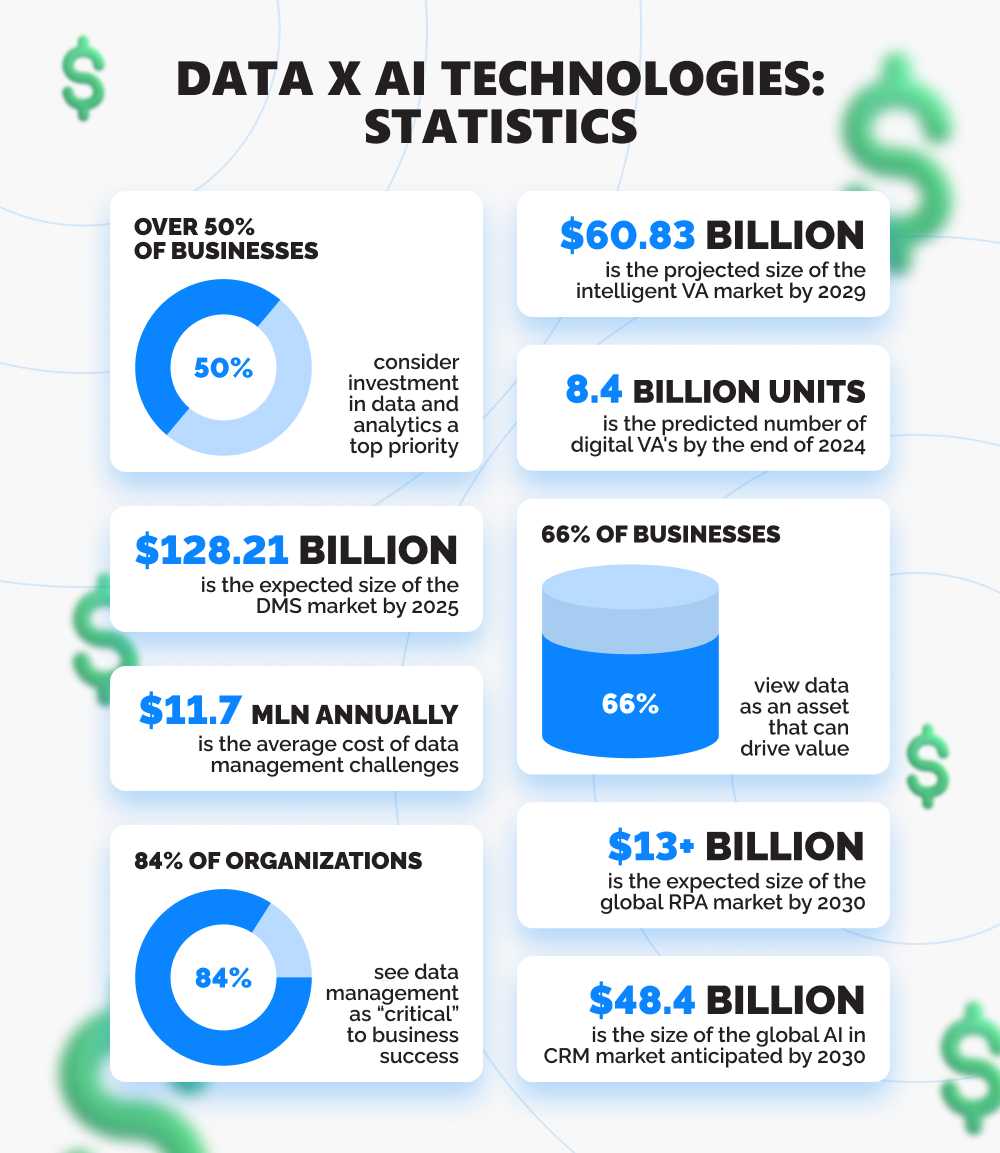
Such cases prove that AI software like GPT assistants and data analysis tools are a perfect duo. Statista backs us up: a 2023 research found that the majority of businesses consider investment in data and analytics a top priority.
The app integration of GPT assistants with data analysis tools allows businesses to:
Among the tools that are already in the spotlight of the data analysis x GPT collaboration, there are:
#2. Data management systems (DMS)
We'd like to introduce you to a couple of facts gathered by folks at Gitnux:
In addition, studies show that employees waste 20% of their time searching for data instead of actually doing their jobs.
And yet again, this is where GPT assistants are able to improve the situation. They can be integrated into a DMS to automatically search, process, and manage large volumes of data to increase the efficiency in handling information. This synergy also has the potential to reduce the risk of error and free up human resources to perform tasks of a bigger importance, like strategic decision-making, problem-solving, crisis management, etc.
As a great example in the field, there's CLAIRE GPT. This GPT-powered assistant can perform routine data management tasks (e.g., data cleaning, integration, and transformation), take on advanced data analysis, provide intelligent recommendation to optimize data management strategies, handle anomaly detection, etc.
#3. Voice assistants
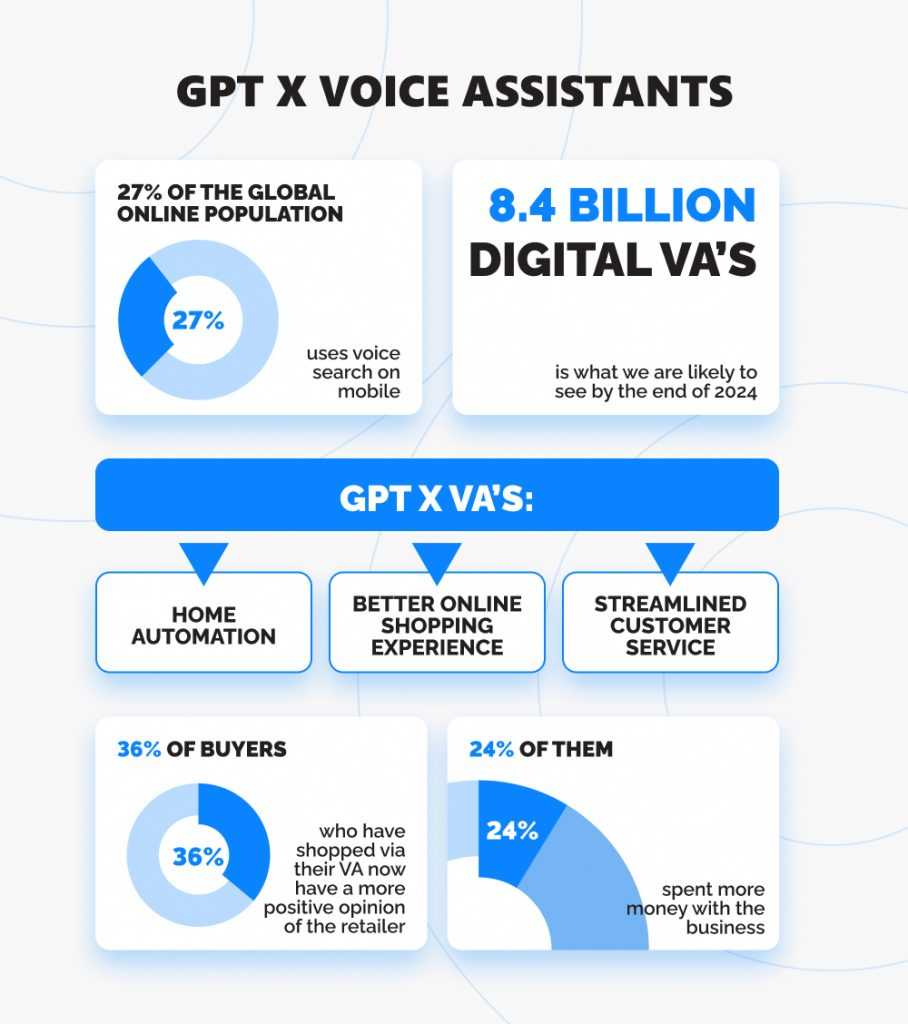
Google found that 27% of the global online population uses voice search on mobile. This means that voice assistants like Siri gain increasingly more attention, while newcomers actively enter the scene. As Mordor Intelligence reports, the intelligent virtual assistant market size is estimated at USD 14.77 billion in 2024, and it is expected to reach USD 60.83 billion by 2029. Statista nods in agreement: by 2024, the number of digital voice assistants is expected to reach 8.4 billion units – a number higher than the world’s population.
The mix of AI and voice assistants goes way beyond handling personal mundane tasks. The duo allows your mobile helper to understand humans better, which entails a broader variety of topics for conversations and a significantly wider spectrum of possibilities. In other words, it's not just about making a call request via voice or scheduling a reminder anymore.
As an example of a GPT-powered voice assistant, there's Lindy AI. Lindy AI is a powerful software that can act as a personal assistant, particularly skilled at automating repetitive tasks and with 3000+ integrations like Google Calendar and Slack. It can also be used as a platform for creating an army, if you wish, of digital employees that can converse with you just like a human.
#4. RPA (Robotic Process Automation) systems
The global RPA market is projected to grow to USD 13+ billion by 2030, which signifies an increase of more than 12 billion compared to 2020 (Statista). Considering the range of things that RPA can help with, it's not surprising: these systems are capable of data extraction, filling in forms, opening and moving files, logging into programs, connecting to APIs, and a lot more. Yet, there's always room for improvement: to increase the efficiency RPA brings to the table, spice it up with GPT. The thing is, programming RPA isn't easy: often times, the systems have complex logic, and it might be challenging and time-consuming to build the product. But with the help of GPT, developers can simply prepare a high-level description of what the system has to do, and the model will translate it into functional code. The amalgamation of GPT assistants and RPA leads to smooth automation of tasks and operations, as well as the decrease in time and costs that processes require. Apart from coding, GPT's natural language processing abilities do come in extremely handy in customer service, document processing, content generation, advanced data extraction, etc.
Take a look at the integration of GPT with UiPath, a leading platform in the field of RPA. This synergy allowed the company to dive deep into larger amounts of their own data, produce more actionable insights, and accelerate intelligent decision-making. The source states that due to the GPT-UiPath combo, a leading e-commerce company managed to reduce response time to user requests by 70% and increase customer satisfaction rates by 45%.
#5. CRM systems
CRMs are all about clients, while GPT models are all about personalization. What happens when these two come together? It definitely becomes easier to navigate and manage customer relationships, as GPT can handle and make use of increasingly more client information. You get to enjoy lightning-fast data processing, unique customer experiences, unlimited scalability, effortless workflow automation, informed decision-making, and many other things. As a result, by 2033, we expect the global AI in CRM market to be worth about USD 48.4 billion (the source).
Interested in finding out more about gen AI in software development? Here's your next good read.
Who Has Successfully Implemented GPT Assistants?
We've already seen several examples of how GPT triggers a change in either an industry or the way a certain technology is applied. Let's continue our journey down the rabbit hole and explore more impressive cases of the GPT application. This time, we'll discuss the results that GPT assistants helped companies to achieve.
Cleo, a personal finance assistant that changes how people handle their money
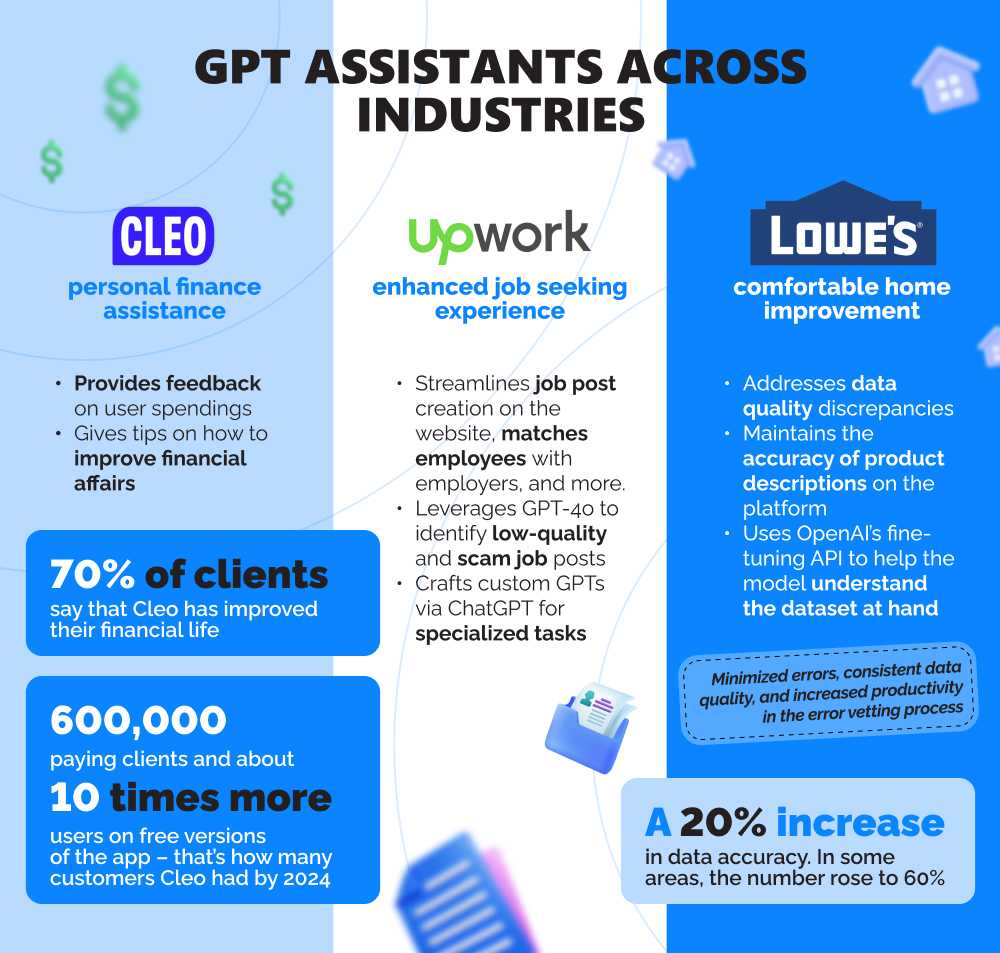
Cleo is a fintech company that was founded in 2016. Originally from the UK, it shifted its focus completely to the US during the COVID-19 pandemic. By 2024, they already had around 600,000 paying clients and about 10 times more users on free versions of their application.
Cleo is an AI assistant that provides feedback on user spendings and tips on how to improve financial affairs. It has a “roast” feature that teases customers for spending recklessly and a “hype” feature that celebrates them for being reasonable about the money. Both features (and everything else that Cleo offers) are 50% new age technology and 50% exceptional sense of humor that the assistant delivers via natural language. In March 2023, they integrated GPT. As the company puts it, “We’ve made a significant breakthrough on the implementation of AI in chat and are one of the few, if not only, consumer facing fintechs to have done so.”
Want to see more use cases of conversational AI in finance? Click the link to read the article.
Upwork: on their way of transforming the job seeking experience with OpenAI
Upwork is the world’s largest work marketplace, and that explains why artificial intelligence had to become an integral part of pretty much every process within the company. “We knew we had to move quickly with our AI adoption, and OpenAI offered solutions for everything we needed. Now we’re able to leverage AI to empower our workforce, and infuse it into our product development process”, the company representative said.
Here are a few AI features that Upwork introduced to their workflow and the results that they were able to achieve afterward:
Elevating data quality and introducing personalization with Lowe’s, a home improvement company
Lowe’s is an American retail company that specializes in home improvement. It has made it into Fortune 50 and processes about 16 million customer transactions each week. With a work volume of that scale, Lowe’s realize both the utter vitality and the extreme complexity of maintaining the accuracy of product descriptions. After all, if product descriptions are wrong, fewer customers can find the required item and complete the purchase.
In January 2023, the AI team at Lowe’s decided to apply GPT-3.5 to address data quality discrepancies. It took them only a few months to register significant improvements. Later on, the company started using OpenAI’s fine-tuning API to fine-tune the model and help it better understand the dataset at hand. The results included:
In January 2024, Lowe’s also introduced Product Expert. That is a custom GPT offering users personalized product recommendations for home improvement needs based on their prompts. Lowe’s product is the first of its kind in the industry. It is available to all ChatGPT Plus paid subscribers.
Heading to the Future with GPT
GPT models have come a long way in quite a short period of time. Now, both GPTs and GPT assistants are actively reshaping our modernity, majorly focusing on humans while trying to resemble them — literally — to the letter.
Considering how advanced GPTs have become, it is hard and paradoxically easy to imagine what the future might look like when the technology matures further. Predictions point at even better understanding of context and nuance in language. That entails the collaboration of GPT assistants and human agents, real-time text translation, and, of course, exceptional customer service. Alongside that there is the consulting part, i.e., assistants could instantly share the required information in any suitable format, and things like emotional support. Today, there already are services like Replika that offer their users the comfort of an AI friend. And while sometimes all this AI talk does sound a bit futuristic, like something out of the Spike Jonze's film “Her”… Is it really that futuristic? Not anymore.
Excited about the future? It's time to start getting ready for it! Contact us to see how AI and GPT can elevate your business and launch your smart apps.
Related articles
About the Author