AI in product development… Is it a good idea? Imagine a world where AI is not a tool, but a team member. It's Monday morning, and your new teammate rolls into the office. Well, not rolls, more like pings the team chat with a cheerful “Good morning!” It doesn't ask for coffee breaks and doesn't mind staying late to deploy that hotfix.
AI seems like a dream employee. The question arises: what value can this non-traditional team member bring to the company? Buckle up as we explore the quirks and perks of “hiring” generative AI to build products.
Hello! I’m AI, Your New Teammate
Over the past few years, the phrase “Age of AI” has echoed through boardrooms, tech conferences, and bars. Some see it as an inspiration for groundbreaking technological progress. Others treat it with caution, convening conferences to debate whether AI is a harbinger of doom or a chance for humanity. The recent emergence of technologies like ChatGPT has emphasized its self-learning capabilities. This advancement has only reinforced the ubiquity of artificial intelligence.
Now you stand at a crossroads: should you welcome AI technology into your team or rely solely on human ingenuity?
Benefits of Human-AI Collaboration in the Development Cycle
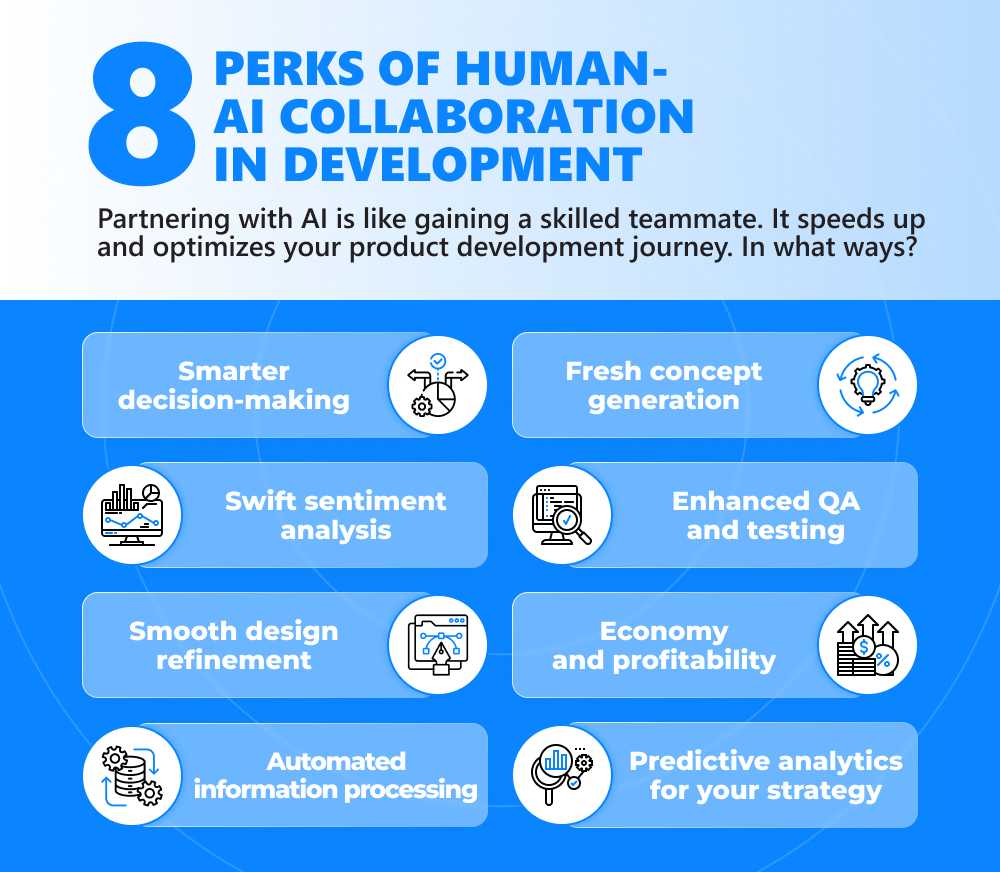
When you choose to collaborate with AI, it opens the door for your new coworker to prove its worth. Take it as a sidekick who doesn't work alone, but rather amplifies your product development efforts.
You're not venturing into uncharted territory. Across the globe, software engineering teams have already joined forces with AI. An IBM survey reveals that 21% of companies now rely on robotic help as part of their daily operations. Among the early adopters, product managers stand out as one of the top 10 user groups leveraging AI.
But how can such a partnership benefit your own development team? Let's explore the role AI plays in the product development lifecycle:
Key Use Cases of AI-Driven Product Development
AI integration goes beyond those quick-witted chatbots doing our jobs. It affects all stages of the product development life cycle. You can see it in the algorithms guessing which products your audience will love next. You can spot it in rigorous product testing before launch. And in virtual interviewers that gather user feedback. Where else?
Project Management
Example:
A product manager at a gaming company uses AI to create a more organized workflow for an upcoming project.
Market Research
Example:
An AI system scans social media and web forums, predicting the rise of eco-friendly packaging before it becomes mainstream.
Product Architecture Design
Example:
An IT startup collaborates with an AI product development company to analyze and refine the architecture requirements for a new cloud solution.
Software Frontend Design
Example:
A frontend designer uses AI to track user navigation patterns. The technology suggests redesigning the checkout functionality to make the process efficient and customer-centric.
Automatic Code Generation
Example:
With an AI coding assistant, a developer quickly generates the necessary API calls and front-end code, ensuring error-free operation. AI also offers optimizations, reducing page load time by 50%.
Automated DevOps
Example:
In a large online store, an AI system monitors server health and traffic dynamics. During a flash sale, it predicts server overload and dynamically redistributes the load. Thus, it guarantees a smooth shopping experience for millions of customers.
Product Security
Example:
A product security specialist at a bank decides to integrate AI for tracking network traffic. The smart tool detects a pattern of unauthorized access attempts. Then, it automatically triggers anti-malware measures, thwarting potential data leakage.
Quality Assurance
Example:
A QA specialist works with AI to automate the testing of a new mobile app. They run thousands of tests across several devices and operating systems. As a result, they identify previously undetected bugs.
Digital Marketing
Example:
A fashion brand marketer uses AI to segment their clientele. They analyze purchasing behavior and customer preferences to personalize email campaigns. This approach helps to multiply click-throughs and conversions.
Valuable AI Tools for Product Development
What's the word on AI-based tools for such a wide range of applications? Here's a handy table with noteworthy examples across various domains:
Possible Risks and How to Tackle Them
Plenty of goodies, right?
The allure of AI in the production process is undeniable, promising a goldmine of possibilities. Yet, the case for AI is still not clear-cut. Just recently, notable celebrities have raised concerns by signing open letters opposing “AI Music-Generation Technology”. So, should you proceed with caution in the field of product development?
Let’s explore the risks that lie ahead and chart a course to navigate them.
Context? What Is It?
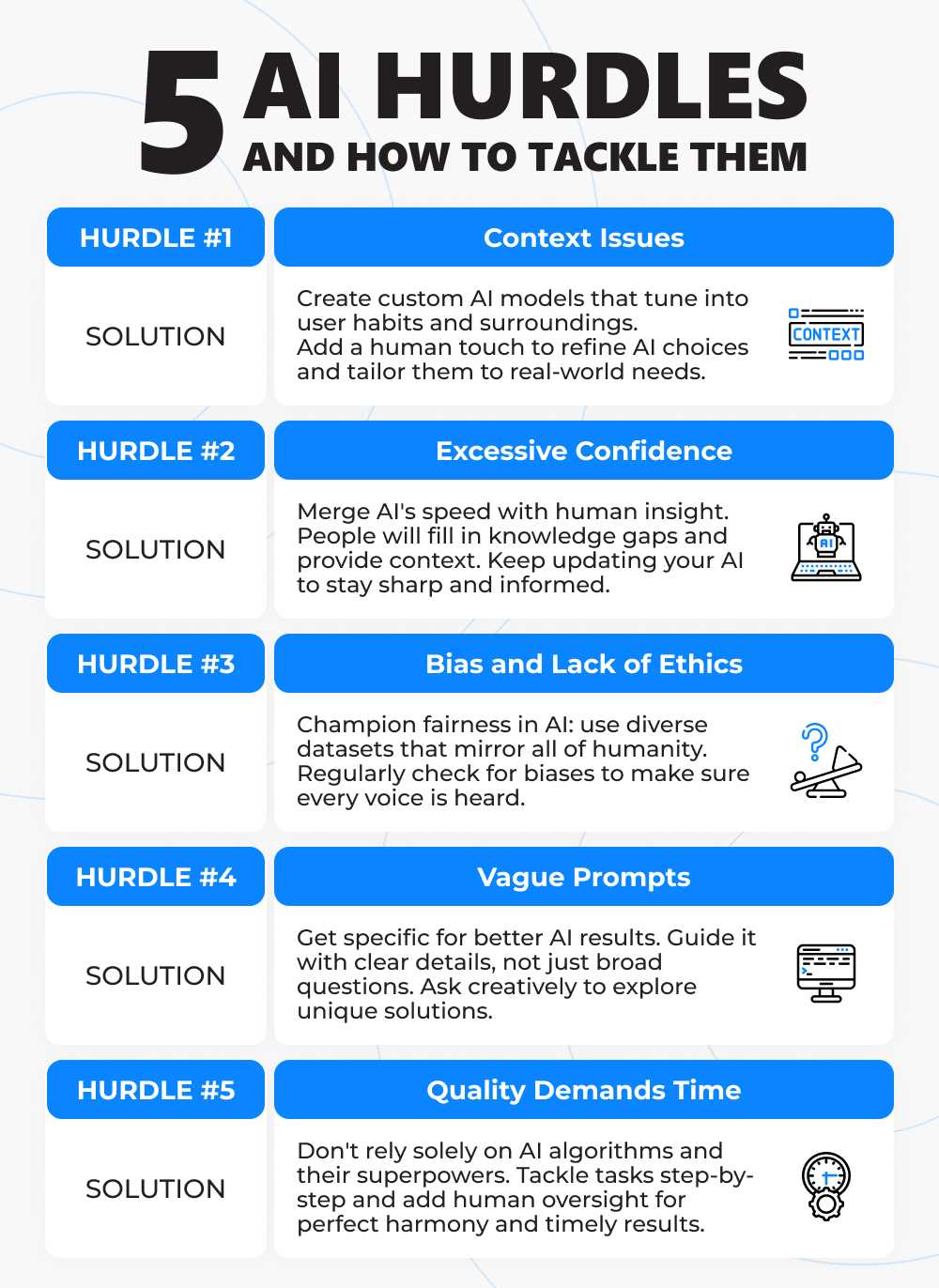
Unlike humans, AI systems lack a fine-grained understanding of context. They can take logical actions based on data alone. That's why AI sometimes seems tone-deaf or offensive. Without context awareness, its actions may conflict with social or ethical norms.
Solution:
Develop custom AI models that explicitly heed context cues, such as user history or environment. You can also try implementing human-in-the-loop systems systems to validate AI decisions and make context-aware adjustments.
Brainiac? Not Your Know-It-All
If terms like “machine learning tools”, “natural language processing”, and “computer vision” suggest AI knows everything on the internet, think again. The truth is: AI isn't omniscient. Despite its prowess, it can be overly confident, even when uncertain, leading to errors.
Solution:
Try to combine AI's speed with human judgment. People will fill in knowledge gaps and provide context. And remember to regularly update your models to refine their AI expertise and adapt to new information.
Ethical and Unbiased? Look Harder
AI learns from historical data, which often carries inherent biases. Plus, it can't always grasp evolving social norms. What was acceptable yesterday may no longer hold true today. And therein lies the risk: perpetuating discrimination against certain groups of individuals.
Solution:
To address ethical concerns, prioritize inclusive, representative datasets. Ensure they reflect the rich tapestry of humanity, not the majority. Regularly audit your training data for hidden biases. Especially regarding underrepresented groups — their voices matter.
User-Friendliness? Not Its Thing
Using tools like ChatGPT or Midjourney for generative AI product development reveals a unique skill set. Why is that? AI doesn’t create content out of thin air. It relies on existing data it was trained on. Your ability to “talk” to AI — that is, to craft meaningful queries — directly affects the quality of its responses.
Solution:
Specifics yield richer results. Thus, always provide the machine with context rather than a vague query. Instead of “Tell me about PMs and deadlines,” try asking, “Is it possible to invent a device that erases memories to make a PM forget about deadlines?”
Last-Minute Helper? 50/50
AI product development indeed enhances efficiency and productivity. But the notion that it magically solves the “need-it-done-yesterday” challenge is misleading. Crafting exceptional products involves more than an artificial intelligence design assistant alone. AI can't warp time. Quality still demands deliberate effort from product developers and designers.
Solution:
Missed deadlines? Don't rely solely on AI algorithms and their superpowers. Recognize their boundaries. To succeed, break tasks into manageable steps so the machine can handle them sequentially. Spice up the process with human oversight. It won't be an obstacle to the entire process, but a push for a balanced outcome.
Generative AI for Product Development: Future Trends
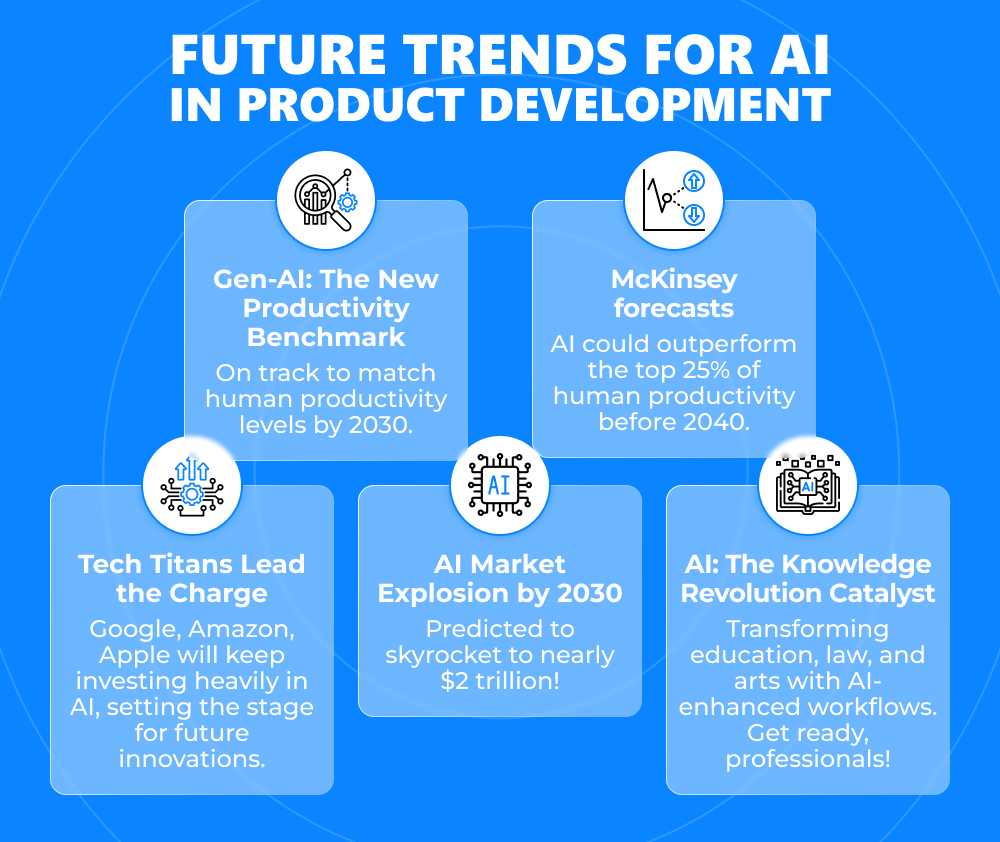
What will the global AI market be like by 2030? Statista predicts remarkable growth to nearly $2 trillion! But what factors will drive this surge? Here are some trends we may see shortly:
Ready to Get Started with AI Product Development?
Misguided are those who assume that AI is purely about sentient robots or science fiction fantasies. Instead, its essence lies in amplifying human creativity, doubling operational efficiency, and nurturing innovative ideas all along the product development journey. Luc Julia, co-inventor of Apple’s Siri and Renault’s Chief Scientific Officer, succinctly captures this point: “There is no intelligence in AI, but there is knowledge – of data and of rules – and there is recognition… Machines don’t invent anything; what they produce comes solely from the data we put into them.”
The success of your AI product development depends more on your dedication to the technology than just the complexity or newness of the AI model. With the right product development strategy and a qualified team, the unparalleled perks of AI — enhanced functionality, efficiency gains, and competitive advantage — are well within your reach.
_Struggling to find a seasoned AI partner? Drop us a line. Our experts will blend data science, machine learning, and deep domain knowledge to craft your intelligent solution. _
It's the strategic integration of AI technologies into product development processes. In its essence, it's all about using artificial intelligence to simplify software engineering tasks, speed up project timelines, and create better products.
Sure! But remember that artificial intelligence (while still in its infancy) cannot completely replace designers and developers.
Here are the areas where AI can significantly contribute to product design:
Related articles
About the Author