Today, digital marketing for enterprises extends far beyond newsletters and landing pages. It’s about crafting a multichannel engagement strategy. The goal remains the same: to bring customers to the place where conversion happens — your website. It’s where you are in charge. You control the composition and wrapping of your products, influencing whether your audience decides to engage or move on.
Yet, technological constraints can hinder the ideal enterprise website vision. That is why many businesses turn to enterprise CMS platforms. How do you choose the right one? Join us as we delve into a comparison of the top 5 market leaders.
CMS for Enterprises: When the Ordinary Is Not an Option
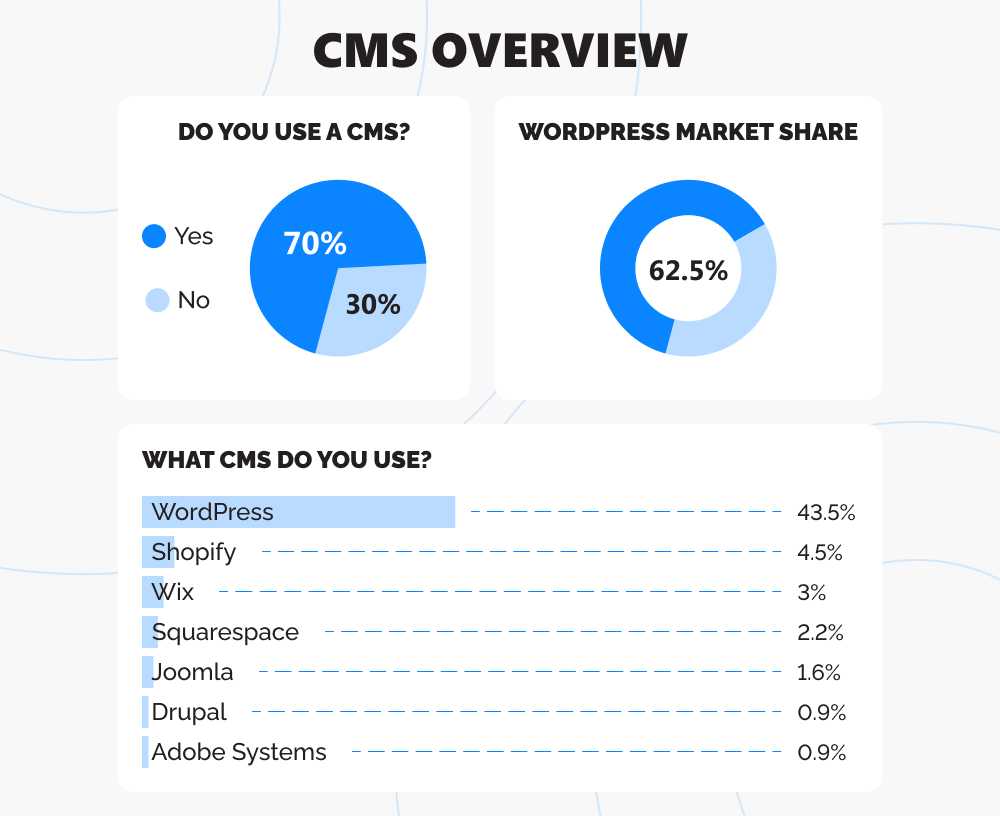
According to a study by W3Techs, nearly 70% of companies use a content management system (CMS). Leading the pack is WordPress, powering 43.5% of all websites and commanding a market share of 62.5%. There are, however, other powerful CMS options out there. But are they all suitable for large corporations?
What Is an Enterprise CMS Platform?
As the core tool for marketing content creation and publishing, a CMS is a skillful assistant to the marketing team of any enterprise. If your organization is considering adopting or upgrading a CMS, keep in mind that enterprises should opt for an appropriately sized solution, namely an enterprise-grade CMS. What sets it apart?
An enterprise CMS is a sophisticated content management system designed to serve the complex needs of large organizations. Unlike standard CMSs, enterprise-grade software boasts advanced functionality such as:
Features to Look for in Enterprise CMS Platforms
If you Google for “top enterprise CMS”, you'll find a flood of options competing for your attention. Some CMS vendors will lure you with features their competitors lack. Others will boast a wild array of available languages or a unique approach to branding. At first glance, all CMS platforms may appear similar to you. Yet, in the realm of enterprise CMSs, the stakes are higher. You need everything a standard solution offers but with an “enterprise” flavor, right?
To help you navigate through the overwhelming choices, here's a list of must-have features that your “right enterprise CMS” should include:
1) Enterprise-Level Security
With the average cost of a data breach soaring to $4.88 million in 2024, it's evident that enterprise security must be uncompromising. You must ensure it at every level, from customer data encryption to content and digital asset management.
The CMS you select should exemplify a strong commitment to security by offering tools to:
System administrators must be able to perform audits, review application health, and identify performance bottlenecks to prevent compliance and safety issues. On top of that, your CMS must adhere to GDPR, CCPA, and other regulatory requirements, as well as certifications like ISO 27001 and SOC2.
2) Intuitive Content Editor
Content is the lifeblood of your CMS. Thus, a software solution should offer marketers and content editors an easy-to-use workspace to craft captivating digital experiences.
As the majority of users lack deep technical expertise in web development, the platform must support drag-and-drop functionality and editing with WYSIWYG (What You See Is What You Get) tools. These features allow users to manage content independently across multiple channels without extensive training: publish content, launch PR campaigns, and create eye-catching marketing materials.
3) Localization Opportunities
For large organizations, attaining global recognition means publishing content in multiple languages. It's not just about expanding reach; it's about meeting audience expectations. According to CSA Research, 87% of clients wouldn't buy from an English-only website. Therefore, effective localization directly translates to customer acquisition and retention.
Top enterprise CMS platforms must excel at content localization to deliver a stellar customer experience (CX). A solution that simplifies multilingual creation of content, web pages, and digital assets while respecting cultural nuances is what global brands should strive to find.
4) Headless Architecture
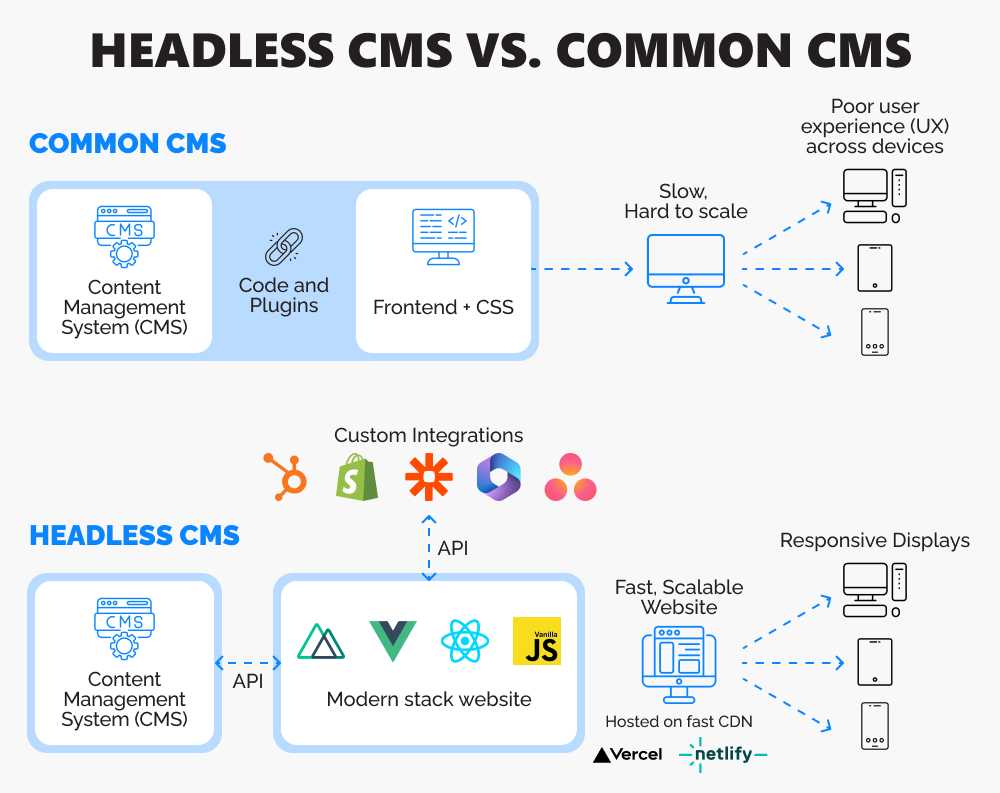
A headless CMS decouples the frontend (what users see) from the backend (content management). This separation enables businesses to create unique digital experiences across multiple websites, mobile apps, and IoT devices. The beauty of headless solutions lies in their independence from any specific frontend framework. It guarantees a consistent user experience across all platforms.
For developers, such a CMS architecture is a dream come true. They can use the highest-performing tools and frameworks for each project — React, Angular, Vue.js, or any other technology. This freedom boosts productivity and sparks innovation, unshackled by the limitations of traditional template-based content management systems.
5) Extensibility and Integrations
A comprehensive content management solution is critical to managing the digital user experience. But it isn't the only tool recommended. The ideal CMS platform should be extensible through APIs to integrate with other business systems.
Headless platforms excel in this area. They allow seamless integration with existing and new environments for tasks like analytics, marketing automation, e-commerce, and cybersecurity. Some services offer built-in integrations that simplify CMS setup, making it easier to link other digital marketing tools.
6) Omnichannel Content Delivery
Flawless content delivery across all digital touchpoints — websites, mobile apps, social media, in-store kiosks, etc. — is another goal every enterprise-level company should aim for. With API-based or headless architecture, enterprises can maintain a consistent brand presence regardless of device or platform. How so?
Customers can start interacting with a brand on one device and continue on another without any disruption. For example, a client may begin researching a product on their smartphone, add it to their cart on a tablet, and complete the purchase on a desktop. Throughout this journey, the brand experience remains consistent and uninterrupted. This approach engages audiences and maintains brand integrity across all channels.
Leading the Pack of Top Enterprise CMSs: Our Top 5 Picks
In the race for digital dominance, the right CMS can be your secret weapon. We've scoured the market to bring you the crème de la crème of enterprise CMS platforms.
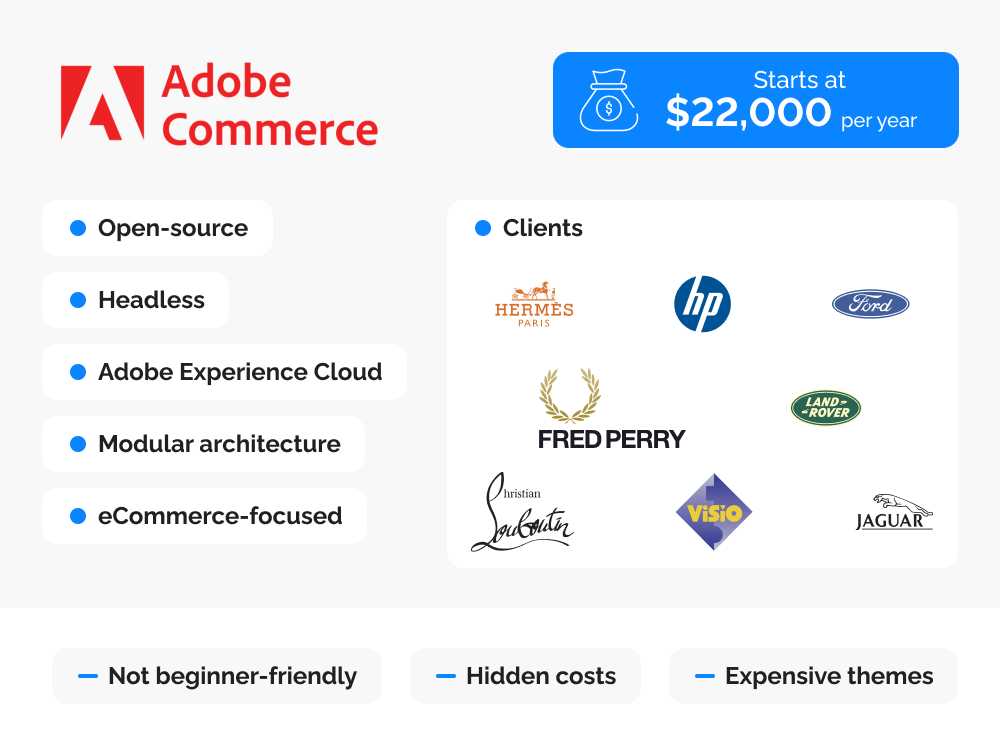
#5. Adobe Commerce (Formerly Magento), the E-Commerce CMS
Architecture:
API-first, headless CMS
Use Cases:
Since its transformation from Magento in 2018, Adobe Commerce has emerged as a powerhouse CMS platform geared towards serious, global eCommerce brands. If you're a major player in a high-volume market, Adobe Commerce can fulfill your requirements with precision. Although it has a steep learning path, the benefits of security, scalability, and customization make it worth the effort.
A tip for first-time users: to get a taste of what Adobe Commerce is all about, a free open-source version is available.
Key Features:
Weaknesses:
Client Testimonial:
Chris Hammond, Global Digital Director at Helly Hansen, shares:
“Adobe has given us the power to create unique and engaging customer shopping experience. There are many rich, out-of-the-box features and seamless third-party integrations we can utilize.”
Pricing:
Starts at $22,000 per year.
#4. WordPress VIP, the Premium WordPress CMS
Architecture:
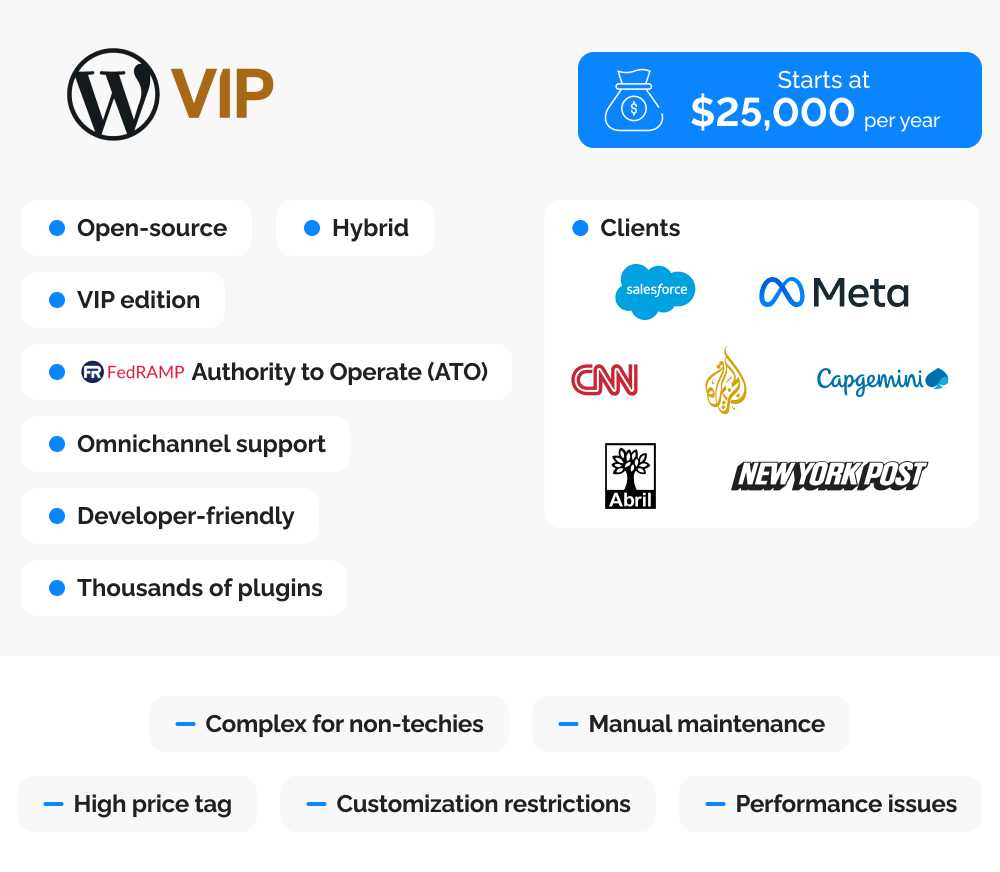
Hybrid CMS
Use Cases:
“Stop hating your CMS.” This bold statement welcomes users of WordPress VIP, the premium enterprise version of the ubiquitous WordPress.
In 2006, WordPress, which runs over 478 million websites, introduced a VIP edition for enterprises. The popularity of its parent platform allows WordPress VIP to proudly proclaim: “The best companies run the web with WordPress VIP”. But what sets it apart?
Key Features:
Weaknesses:
Client Testimonial:
Bedirhan Cinar, Head of Product and Digital Engagement at Ford Foundation, says:
“Ultimately, we chose WordPress VIP because of its ease of use, general familiarity, and the number of agencies available due to its adoption rate.”
Pricing:
Starts at $25,000 per year.
#3. Contentful, the API-First CMS
Architecture:
API-first, headless CMS
Use Cases:
Contentful stands out from traditional CMS platforms by breaking content into small, reusable components. This composable architecture allows users to create content once and republish it across brands, channels, and regions.
Developers appreciate Contentful's API-first approach, which accelerates the development of digital services. Content creators love its intuitive interface that simplifies content production. The platform's decoupled architecture brings greater scalability and rapid deployment, making it a preferred choice for organizations aiming to expand their global marketing reach.
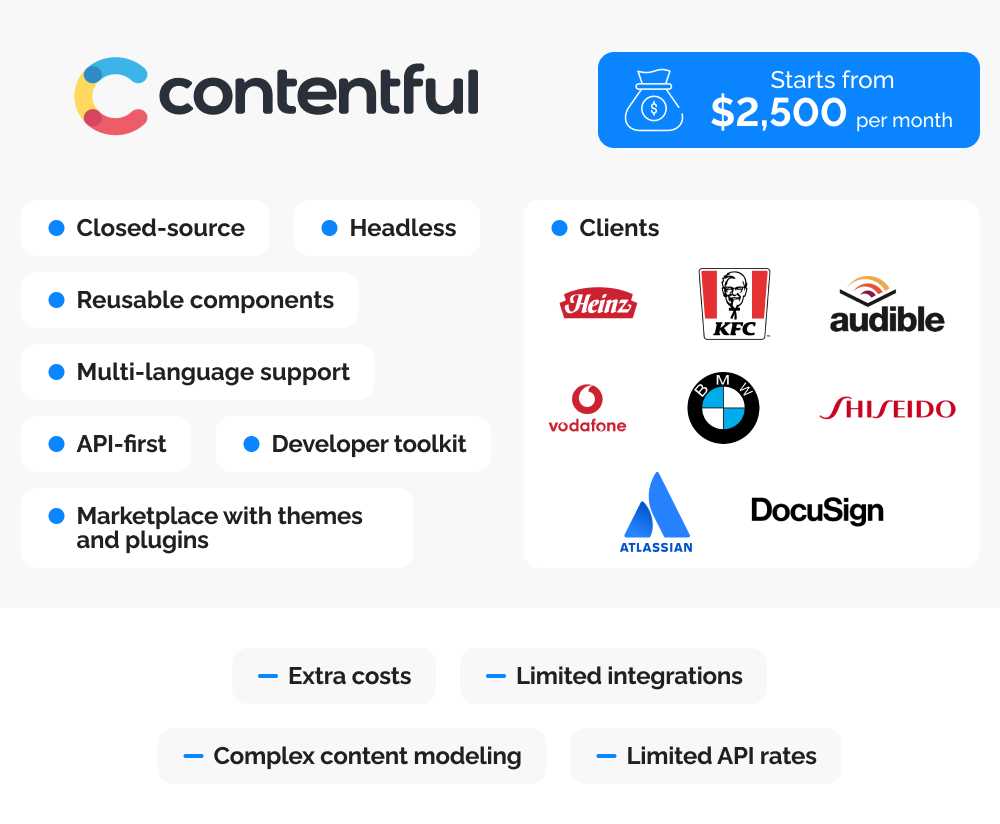
Key Features:
Weaknesses:
Client Testimonial:
Nathan Cook, Global Marketing Director, Web Development at Audible, shares:
“We’re empowering marketers and designers to be able to execute on their vision without having to wait for developers to build it out.”
Pricing:
Starts from $2,500 per month (on request).
#2. HubSpot CMS Hub, the Marketing-Focused CMS
#3. Contentful, the API-First CMS
Architecture:
Hybrid CMS
Use Cases:
For businesses already familiar with HubSpot, its CMS edition may be a suitable option. This flexible platform integrates web content management with HubSpot's broader suite of marketing, sales, and service tools. User-friendly design, deep CRM integration, personalized content delivery, and lead management all rolled into one.
HubSpot CMS is ideal for marketing-focused organizations that have already invested in the software ecosystem and don't need omnichannel content delivery. As a final note, this solution is not headless. If your company delivers complex digital experiences and tons of content across multiple channels, you'd better off looking at other CMS platforms.
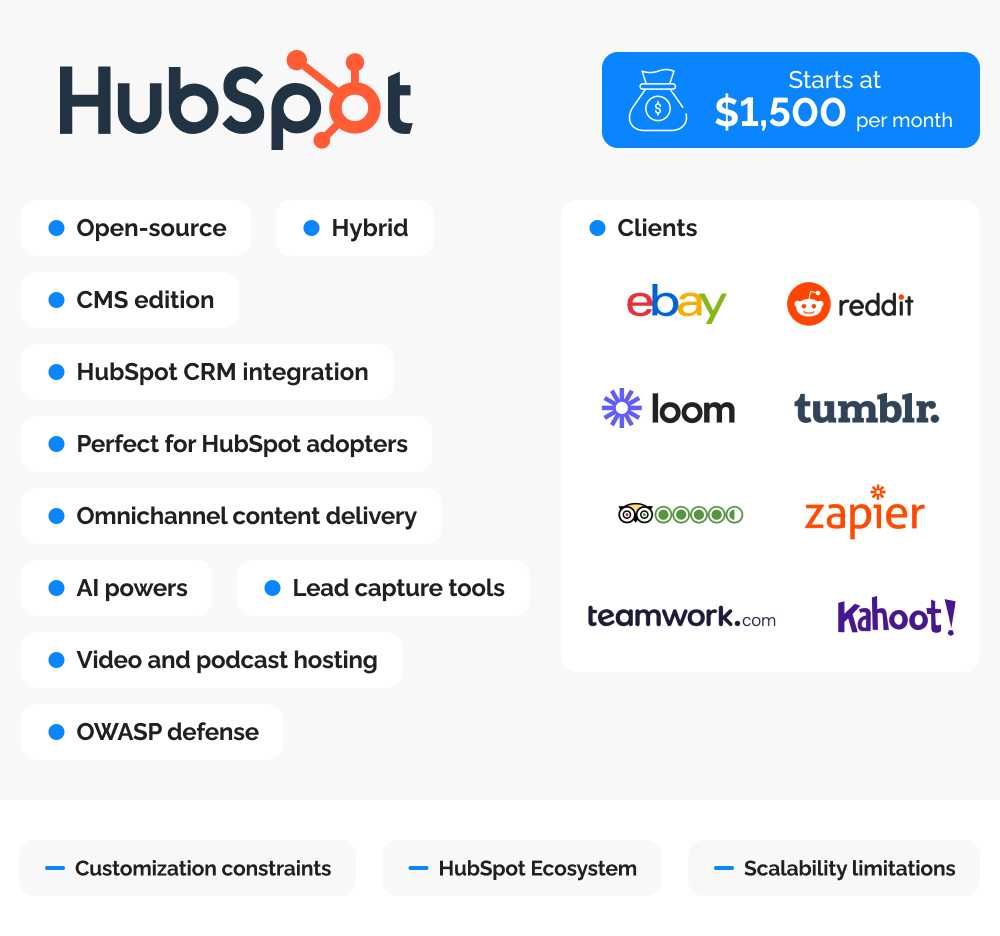
Key Features:
Weaknesses:
Client Testimonial:
Jean Pierre Barroilhet, Inbound Marketing Manager at Rankmi, says:
“Everything's really connected. That's one of the main advantages of using HubSpot.”
Pricing:
Starts at $1,500/month.
#1. Umbraco, the Friendly CMS
Architecture:
Headless and composable CMS
Use Cases:
Rounding out our ranking is Umbraco, “the friendly CMS”. While this description may seem too simple for an enterprise-grade platform, its user-friendly interface is its greatest strength. Why struggle with complex features if you can't find or use them?
A customer-centric approach is key for Umbraco. The company understands the importance of developing intuitive solutions packed with features for integration, extension, and customization to support omnichannel and e-commerce strategies.
Since its launch in 1997, Umbraco's open-source community has grown to over 250,000 members worldwide, with 1,500 digital agency partners. In the latest release, version 14, the development team has re-architected the platform for enterprise-level scalability and ongoing digital transformation.
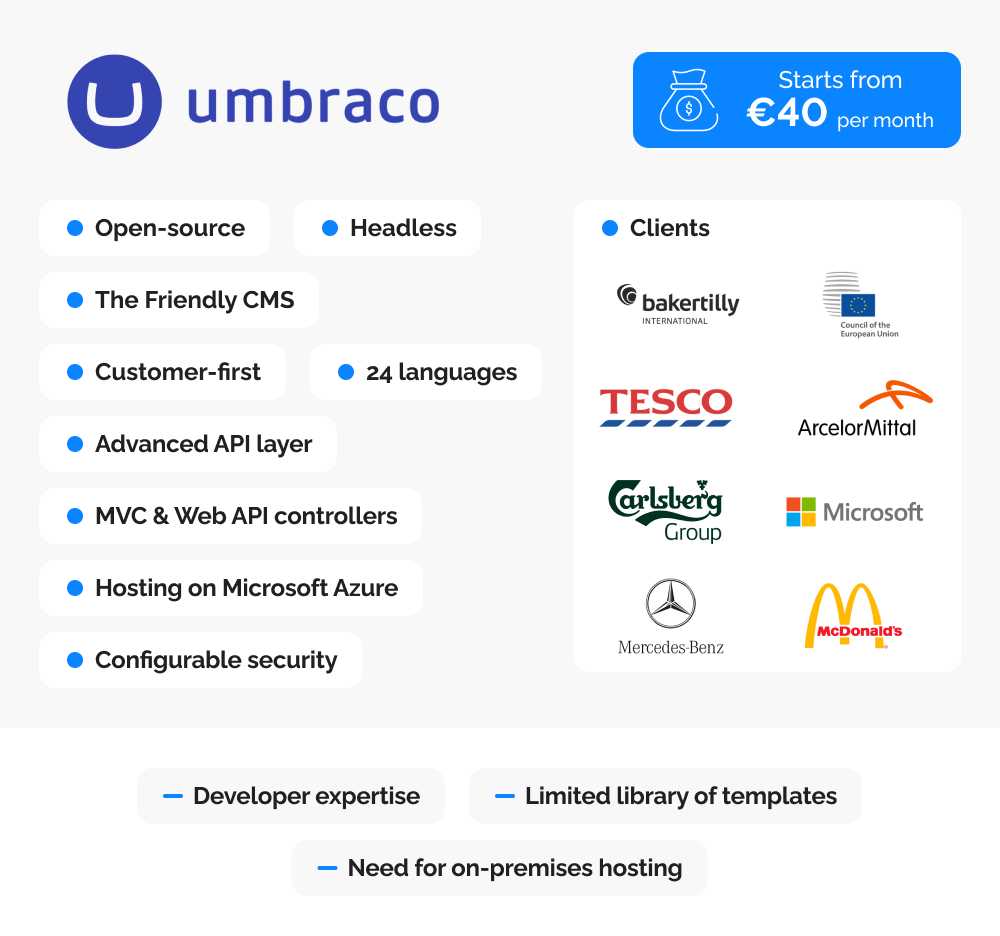
Key Features:
Weaknesses:
Client Testimonial:
Martin Majlund, Group Marketing Technologist at Carlsberg Group, says:
“Umbraco Cloud enables us to migrate several hundreds of local brand websites into a common framework, where all content and functionality seamlessly travels and gets re-used internally between brands and markets and externally between platforms and devices. So Umbraco Cloud has not only proven significant cost savings but also made our brand presence much stronger by increasing our organic traffic dramatically and making all content accessible at any time on any device.”
Pricing:
Starts from €40/month.
You’ve Picked the Best Enterprise CMS Solution, What’s Next?
One day you will choose a new CMS for your team. It may be the most popular one with rave reviews or a newcomer with unique functionality and a fresh look. But the real hard work begins with implementation. You'll need a detailed to-do list, an implementation schedule, and thorough training for your team.
Setting up an enterprise content management system can be lengthy and potentially costly, but it doesn't have to be complicated. Even if your team lacks the expertise, consider hiring an outsourcing partner to assist.
Not sure where to find such a partner? How about the Qulix team?Contact us today to get your website CMS-powered and experience the difference a professional touch can make.
Related articles
About the Author